

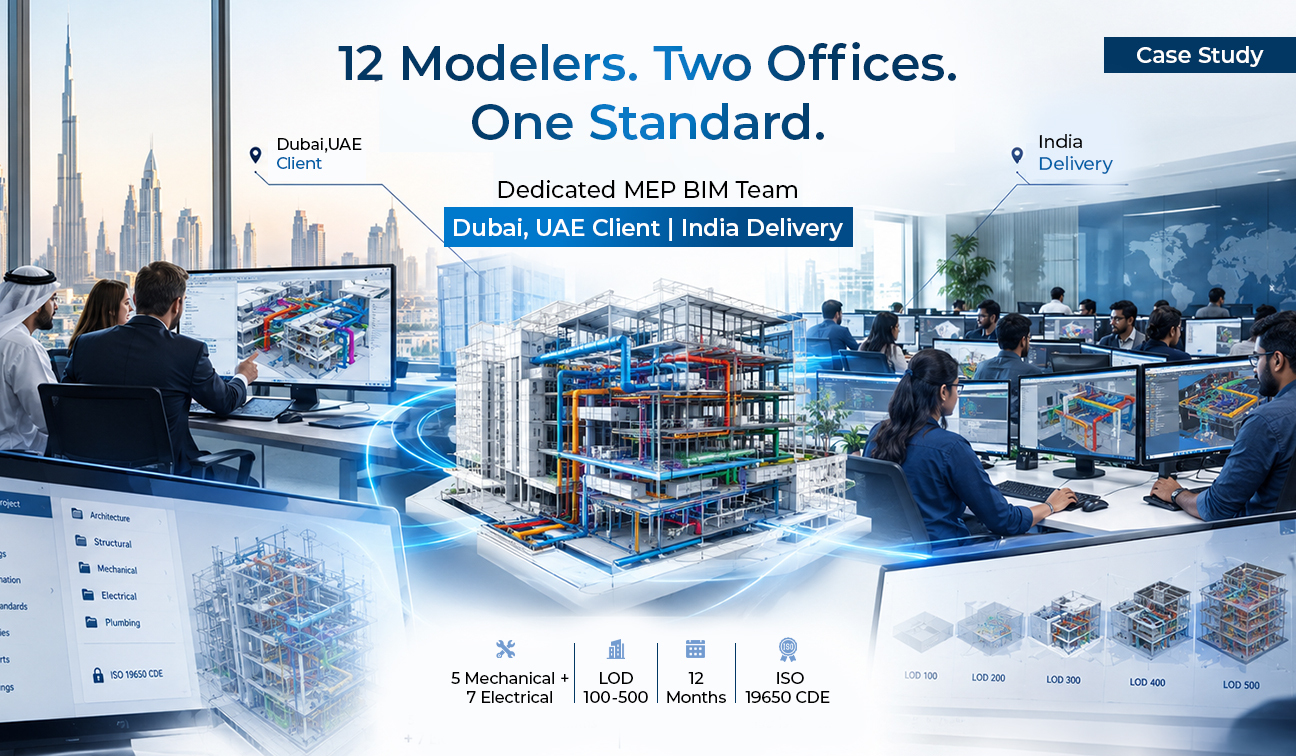
CASE STUDY | BIM STAFF AUGMENTATION
A Dedicated 12-Person MEP BIM Modeling Team for a Dubai Consultancy, Delivered Across a Planned Two-Phase Transition
BIM Staff Augmentation | MEP Modeling | UAE Client, India Delivery
| Client | Dubai-based consultancy |
| Engagement Model | Dedicated BIM team supporting the client's engineers across multiple projects |
| Team | 12 Senior MEP modelers: 5 mechanical and 7 electrical, each with 5 to 8 years' experience |
| Term | 12 months, in two phases |
| Standards | Client BIM Execution Plan, LOD 100 to 500, ISO 19650 Common Data Environment |
Project Background:
A Dubai-based consultancy needed more BIM production capacity behind its engineers, across several live projects at the same time. It brought in eLogicTech to supply a dedicated team of 12 senior MEP modelers for a 12-month term.
The team started out working from eLogicTech's Hyderabad office and, three months in, moved into the client's own Hyderabad office for the remaining nine. That handover between locations was a requirement written into the agreement itself.
The Challenge
Putting twelve modelers behind a client's engineers is not mainly a headcount exercise. The work had to follow the client's BIM Execution Plan, reach whatever Level of Development each project stage called for (anywhere from LOD 100 to LOD 500), and arrive clash-checked and coordinated across architecture, structure and MEP before it was submitted, not after.
On top of the modeling, the client's files had to stay under control for the whole engagement, and production could not stall when the team changed buildings partway through.
How the Engagement Was Structured
The 12 months were split into two phases, with the move between them planned up front rather than left to chance.
PHASE 1 — Production from eLogicTech's Delivery Centre (3 months)
- All 12 modelers worked from eLogicTech's Hyderabad office. eLogicTech supplied the dedicated workspace, licensed software, a secure restricted-access server for client files, and power backup, all in place before modeling began.
TRANSITION — A Planned Handover Between Locations
- The move followed a Transition Plan agreed with the client: a handover schedule with clear milestones, testing and validation of IT infrastructure and work processes, transfer of data and licences, and a risk mitigation strategy. Software and IT assets were disclosed to the client ahead of the transition date so nothing would hold up work on the day.
PHASE 2 — Embedded in the Client's Office (9 months)
- The team continued from the client's own Hyderabad office, using the client's workspace, IT assets and licences. Client BIM files were moved to the client's designated server, and eLogicTech's copies were to be deleted within seven days, with a written certificate of deletion.
Quality Built into the Workflow
Every model went through the same gates, whichever phase or location the team was working from. Clash detection ran in Navisworks or Solibri, and conflicts were resolved before a model was submitted. Models were issued into a Common Data Environment in line with ISO 19650 and the client's own requirements, and updated continuously against project milestones.
Reporting followed the client's cadence as well: detailed timesheets and a progress statement in the format the client required. If a schedule came under pressure, the commitment was to add resources to protect it rather than let it slip.
Deliverables
- A dedicated team of 5 senior mechanical and 7 senior electrical modelers for 12 months
- 3D BIM models at the Level of Development each project specified, from LOD 100 to LOD 500
- A BIM Execution Plan followed in line with the client's standards
- Coordinated multi-discipline models covering architectural, structural and MEP elements, with clash detection resolved before submission
- Model submissions to a Common Data Environment compliant with ISO 19650
- Quantification and scheduling outputs for the client's cost analysis and project execution
- Final handover in native Revit format, with structured IFC exports for asset management
The Engagement at a Glance
|
12
Senior MEP modelers (5 mechanical, 7 electrical)
|
12
Month engagement across two phases
|
100-500
LOD range covered
|
| What the Engagement Had to Match | What Stayed Consistent |
|---|---|
| The client's own BIM Execution Plan and LOD requirements, project by project | One modeling standard across the mechanical and electrical disciplines |
| A mid-engagement move from the vendor's facility to the client's own office | Production continuity through a Transition Plan agreed in advance |
| Strict handling rules for the client's files and data | Restricted-access storage, secure transfer and certified deletion |
Why This Model Works
The consultancy wasn't buying finished drawings at the end of a phase. It was buying capacity that behaves like part of its own team: working to its standards, reporting on its cadence, and able to move into its office without losing a week. Agreeing the hard parts at the start (the standards, the data rules, the handover plan) is what lets twelve modelers slot in behind a client's engineers instead of running a parallel process beside them.
Need a dedicated MEP BIM team that works to your standards and moves in when you need it?
Talk to eLogicTech.www.elogictech.com | sales@elogictech.com
Need Help?
Don't hesitate to contact us for more information about company or service