

New construction gets the attention. But the bigger story in global AEC right now is everything that was already built.
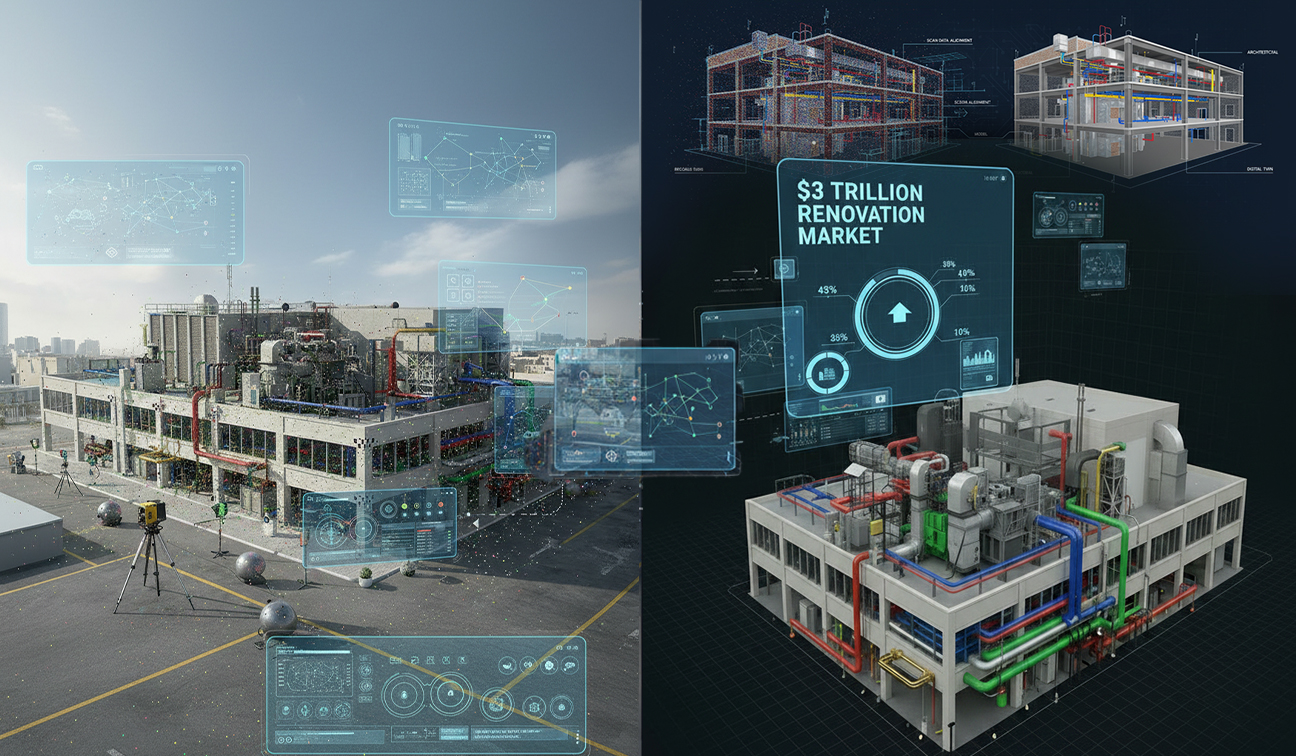
The global building renovation and retrofit market has crossed the $3 trillion mark — and it’s growing. Aging commercial stock, tightening energy codes, adaptive reuse mandates, and post-pandemic repositioning of office space are all driving a wave of renovation activity that dwarfs new-build pipelines in many markets.
And every single one of those projects has the same foundational problem: nobody has accurate documentation of what already exists.
That’s exactly why Scan-to-BIM demand is accelerating. And for AEC firms that haven’t yet made it a core capability, the window to build that competency is closing fast.
The $3 Trillion Problem: Working Blind on Buildings That Already Exist
Most existing buildings were designed in 2D. Many have no documentation at all — or documentation so outdated it reflects the building as it was designed, not as it was built, and certainly not as it stands today after decades of modifications, tenant improvements, and mechanical upgrades.
This creates a dangerous information gap for renovation and retrofit teams. Designers are working from assumptions. Engineers are coordinating against floor plans that may be 20 years out of date. Contractors are discovering ‘surprises’ in the field that should have been visible in the drawings.
The result is what renovation projects are known for: scope creep, budget overruns, and RFIs that pile up from the first week of demolition. It’s not a contractor execution problem. It’s a documentation problem. And Scan-to-BIM is the solution.
Scan-to-BIM starts with a 3D laser scan of the existing building. The scanner captures millions of data points per second, producing a point cloud — a precise, spatially accurate record of every surface, element, and condition in the building as it physically exists today.
That point cloud is then processed and used as the reference base for building an accurate as-built Revit model. The result is a fully coordinated BIM model that reflects reality, not design intent.
For renovation and retrofit projects, this means:
- Design teams work from accurate existing conditions from day one
- MEP engineers route new systems through the building as it actually is
- Structural engineers can assess real-world member sizes and conditions
- Contractors get clash-free coordination models before mobilization
- Field surprises drop dramatically — because they’re already visible in the model
Three Market Forces Driving Demand Right Now
1. Energy Retrofit Mandates Are Creating Immediate Pipeline
Building decarbonization legislation is moving from voluntary to mandatory in markets across North America, Europe, and Australia. NYC Local Law 97, the EU Energy Performance of Buildings Directive, and similar frameworks are requiring building owners to demonstrate energy performance improvements on timelines that are already in effect.
Every building targeted for energy retrofit needs an accurate as-built model before MEP upgrades can be designed. Scan-to-BIM is the fastest path from an aging building to a compliant one.
2. Adaptive Reuse Is Replacing Demolition.
The economics and sustainability case for adaptive reuse have converged. Converting underutilized office buildings to residential, repositioning retail into mixed-use, and upgrading aging industrial facilities is generating a massive wave of complex renovation projects.
These projects are structurally and mechanically complex. They require precision documentation of existing structure, slab conditions, shaft locations, and MEP infrastructure. Scan-to-BIM is how adaptive reuse teams get that documentation without months of manual survey work.
3. Heritage and Historic Preservation Projects Are Scaling
Historic buildings represent some of the most documentation-deficient assets in the global built environment. They often have no drawings at all, or drawings that bear little resemblance to the built structure after centuries of modification.
Scan-to-BIM has become the standard documentation method for heritage preservation — both for planning interventions and for creating a permanent digital record of structures whose loss would be irreplaceable.
Understanding the workflow helps AEC firms scope Scan-to-BIM projects accurately and set client expectations correctly.
- Field Scanning — 3D laser scanning using instruments like Leica, FARO, or Matterport. Outputs are point cloud files in .RCP and .RCS format.
- Point Cloud Registration — Individual scan positions are stitched together into a unified, spatially accurate point cloud in Autodesk ReCap.
- BIM Modeling — The registered point cloud is linked into Revit. Modelers trace existing conditions — structure, architecture, and MEP — at the required LOD.
- QA & Deviation Analysis — The completed model is validated against the point cloud for dimensional accuracy and completeness.
- Delivery — Final as-built Revit model delivered with supporting documentation, ready for the design team to build on.
Not all Scan-to-BIM deliverables are equal. The difference between a model that accelerates design and one that creates more problems than it solves comes down to a few critical factors:
- LOD clarity upfront. LOD 200 is appropriate for massing and spatial planning. LOD 300–350 is required for MEP coordination and construction documentation. Misaligned LOD expectations are the most common source of rework.
- Scan quality and coverage. Areas with poor scan coverage require judgment calls by the modeling team. Experienced Scan-to-BIM teams document assumptions and flag areas of uncertainty. Inexperienced teams guess.
- Discipline scope agreement. A model scoped for architectural existing conditions only will not serve MEP coordination needs. Multi-discipline scope must be agreed at project initiation.
- QA process. Point cloud deviation reports and multi-stage review are non-negotiable on complex renovation projects.
eLogicTech’s Scan-to-BIM Capability
With 25 years in AEC and a dedicated Scan-to-BIM practice, eLogicTech has delivered point cloud to Revit conversions across industrial, commercial, and institutional building types. Our team works with .RCP and .RCS scan files across Architecture, Structural, and MEP disciplines, delivering as-built models from LOD 200 through LOD 400.
We’ve handled projects where scan coverage was incomplete and good judgment was the difference between a usable model and a liability. Our 3-step QCare quality process applies to every Scan-to-BIM engagement — from a single-floor tenant improvement to a 578,000 sq ft industrial facility.