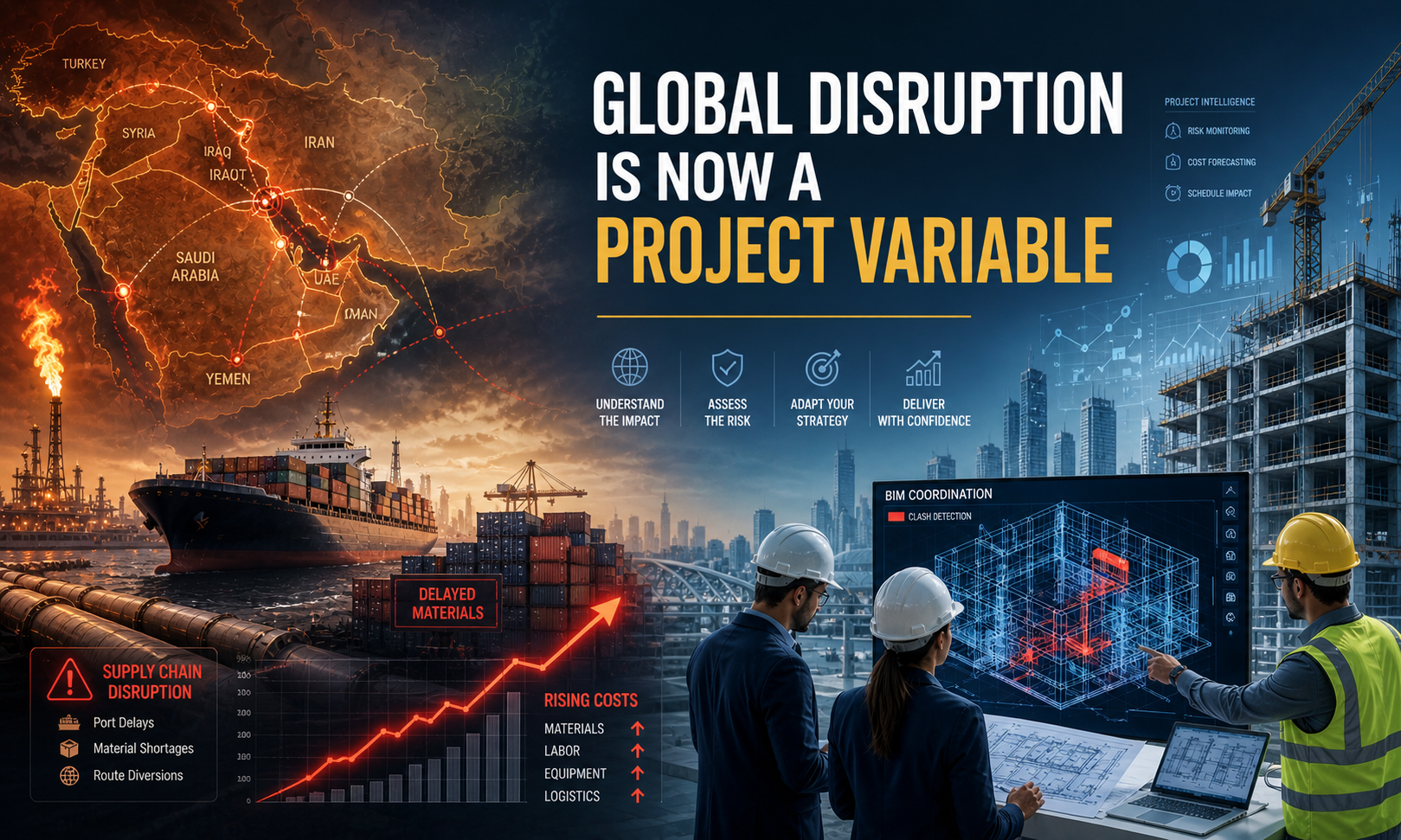
If your project was priced even a few months ago, there’s a strong chance those numbers no longer reflect reality.
What’s happening in the Middle East is not just geopolitical noise. It is directly impacting global energy movement, raw material supply, and ultimately the economics of construction in the United States. The ripple effect is already visible in material pricing, procurement timelines, and contractor behavior.
For AEC firms, this isn’t a scenario to monitor. It’s a condition already affecting how projects are designed, coordinated, and delivered.
A Market That No Longer Holds Still
Construction has always dealt with cost variability, but what’s different now is the speed and unpredictability of change.
Material pricing is no longer moving in cycles – it’s shifting in spikes. Aluminum, steel, and copper are seeing sharp increases, forcing contractors and subcontractors to continuously revise pricing. Specifications created during earlier project phases are becoming outdated before construction even begins.
This creates tension across the project lifecycle. Design teams are being pulled back into value engineering discussions that were already closed. Substitution requests are increasing, often under tight timelines. Contractors are hesitant to commit to fixed pricing, and when they do, it comes with significant contingencies.
The outcome is a breakdown in design certainty. And when design certainty drops, coordination risk increases.
The Hidden Pressure Inside AEC Teams
At the same time, firms are dealing with a challenge that predates the current disruption but is now significantly worse – talent availability.
Hiring experienced BIM professionals, engineers, and QA/QC reviewers has become slower and more expensive. Even when firms succeed in hiring, onboarding and ramp – up timelines delay real productivity.
Meanwhile, project demands are expanding.
Teams are not just delivering drawings anymore. They are managing constant design changes, tracking material substitutions, responding to RFIs, and maintaining documentation for potential claims. All of this is happening within the same deadlines and often with the same team size.
The pressure builds quietly. First in extended work hours. Then in reduced review depth. Eventually, it shows up in missed coordination issues and rework.
This is where most firms underestimate the risk. The issue isn’t workload alone – it’s the compounding effect of workload and reduced QA/QC bandwidth.
When Coordination Becomes the Weakest Link
In stable conditions, BIM coordination follows a predictable rhythm. Models are developed, clashes are identified, and coordination cycles resolve conflicts before construction.
That structure assumes one critical thing: changes happen in an organized way.
Right now, they don’t.
Material substitutions are being introduced late. Cost – driven decisions are bypassing standard workflows. Coordination cycles are being compressed to keep schedules intact.
This is how errors enter the system.
A change made outside the model doesn’t get coordinated. A clash that should have been caught isn’t detected. The issue moves into construction, where it becomes significantly more expensive to resolve.
At that point, the problem is no longer technical – it’s contractual.
The Real Issue Is Not Capacity — It’s How Capacity Is Structured
Most firms respond to pressure by trying to increase internal capacity.
They hire. They extend hours. They redistribute workload.
But this approach assumes stability – that once capacity is added, it will remain efficiently utilized.
That assumption doesn’t hold in the current environment.
Workloads are fluctuating. Some projects slow down due to cost uncertainty, while others accelerate to avoid future escalation. Hiring becomes a risk. Underutilization becomes a cost burden.
At the same time, critical functions like BIM coordination and QA/QC cannot be compromised. These are not optional layers – they are what prevent downstream financial exposure.
This is where traditional staffing models start to fail.
What High - Performing Firms Are Doing Differently
Firms that are navigating this environment more effectively are not relying solely on internal expansion.
They are restructuring how delivery capacity works.
Instead of tying capacity entirely to headcount, they are introducing flexibility into their model. They scale support when coordination demand increases and reduce it when project intensity drops.
More importantly, they are protecting QA/QC as a non-negotiable function.
Rather than allowing review processes to shrink under pressure, they reinforce them – often by introducing independent oversight that is not influenced by project deadlines.
This creates a separation between delivery speed and quality control, which is critical in volatile conditions.
BIM, in these firms, is no longer treated as a documentation tool. It becomes a control system – tracking changes, validating coordination, and preventing issues before they reach construction.
Where eLogicTech Fits Into This Shift
eLogicTech works with US AEC firms as a virtual extension of their internal teams, specifically in areas where pressure is highest – BIM coordination, MEP modeling, and QA/QC.
The focus is not on adding more hands, but on stabilizing delivery where it is most vulnerable.
When substitution cycles accelerate, coordination needs to keep pace. When internal teams are stretched, QA/QC cannot be compromised. When documentation becomes critical for claims, it needs to be complete and traceable.
This is where an external, dedicated layer of support becomes valuable.
It allows firms to maintain coordination integrity without increasing fixed overhead. It ensures that QA/QC remains consistent even when timelines compress. And it provides the documentation discipline required in a high – risk project environment.
The Decision Facing US AEC Firms
The current disruption is not temporary. It reflects deeper structural changes in supply chains, labor availability, and project economics.
Firms that continue operating with rigid delivery models will feel increasing pressure – on margins, timelines, and quality.
Firms that adapt their model – introducing flexibility, reinforcing QA/QC, and treating coordination as a risk function – will operate with greater control.
The difference will not come from working harder.
It will come from working with a delivery structure built for volatility.
Work With eLogicTech
If your projects are experiencing increased coordination pressure, staffing constraints, or QA/QC gaps, this is the moment to reassess how delivery is structured.
eLogicTech supports AEC firms as a scalable, QA/QC – driven extension of their internal teams, helping maintain control even in uncertain conditions.