

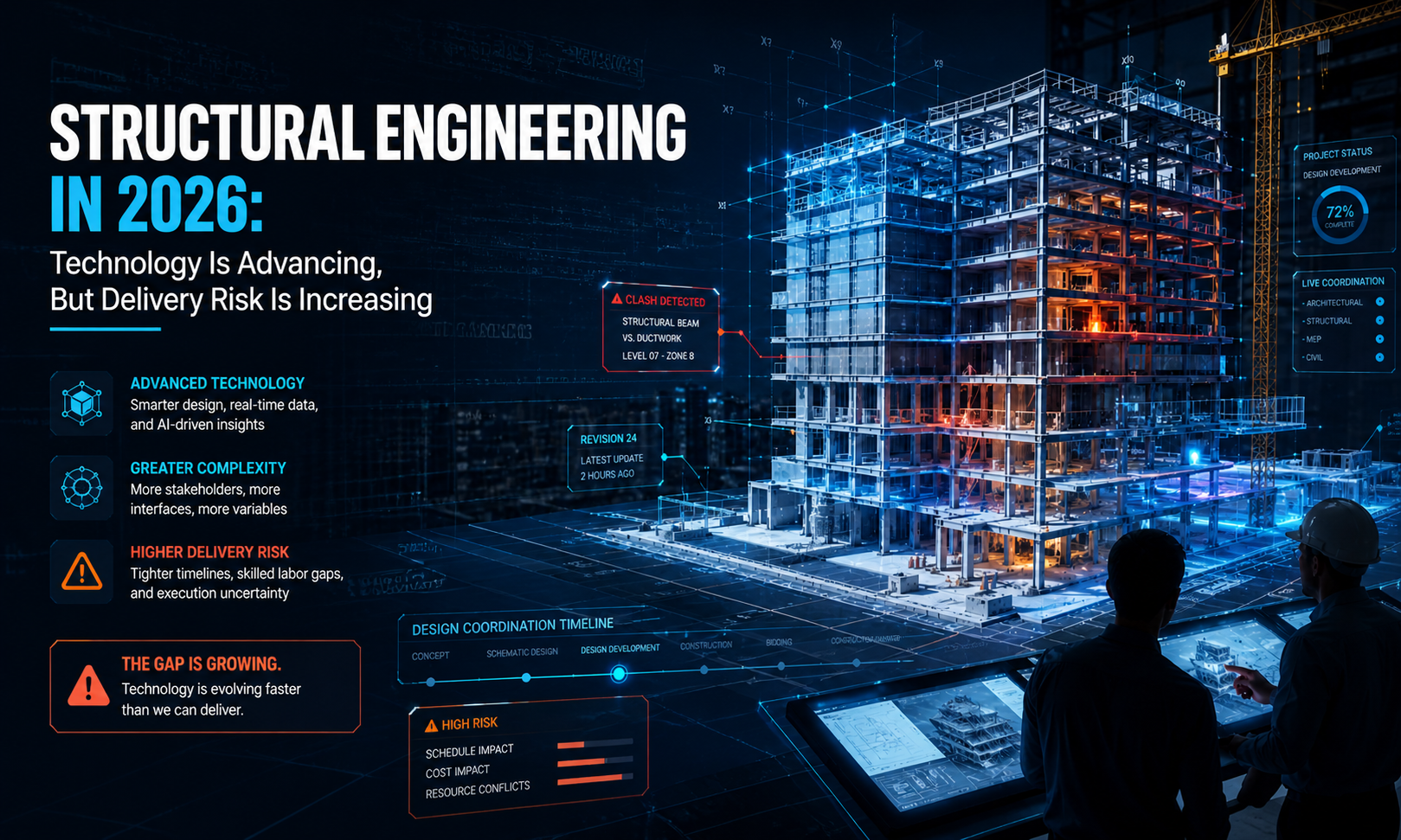
Structural Engineering in 2026: Technology Is Advancing, But Delivery Risk Is Increasing
Structural engineering is often described as a discipline being transformed by technology. BIM platforms are more capable, Revit workflows are more refined, and digital coordination across disciplines is more seamless than at any point in the past.
Yet despite these advancements, many firms are experiencing a different reality inside active projects—one where delivery is becoming more difficult to control, not less.
The contradiction is not accidental. It reflects a shift in how projects are executed, rather than how they are designed.
A More Advanced Workflow — Operating Under Less Stability
The structural design process has traditionally followed a defined progression. Early-stage assumptions are refined through design development, and by the time construction documentation is issued, most variables have been resolved.
That sequence no longer holds consistently.
Design decisions are now revisited later in the project lifecycle, often due to external pressures such as material availability, cost changes, or evolving coordination requirements. Structural systems that were considered stable during earlier phases are being adjusted closer to construction, sometimes after coordination cycles have already been completed.
This introduces a level of instability that structural workflows were not originally built to absorb. The model is no longer a gradually stabilizing output—it has become a continuously evolving system.
Increased Visibility Has Raised the Stakes
Modern BIM environments provide a level of visibility that was not previously possible. Structural elements can now be evaluated in direct relation to architectural and MEP systems, and potential conflicts are easier to identify early.
However, this increased visibility has also raised expectations.
When coordination issues occur today, they are less likely to be attributed to a lack of information and more likely to be viewed as a failure in process. The assumption is that if the model exists, it should have been coordinated.
In practice, the challenge lies not in identifying issues, but in keeping up with the rate at which changes occur. As revisions become more frequent, the effort required to validate each update increases significantly. Without sufficient review bandwidth, even well-developed models can carry forward unverified conditions.
The Pressure Point: Validation Under Time Constraints
Structural engineering has always depended on disciplined verification. The accuracy of a model is not determined solely by how it is created, but by how rigorously it is reviewed.
What has changed is the environment in which that review takes place.
Project timelines have become tighter, and coordination cycles are often compressed to maintain schedule commitments. Under these conditions, review processes tend to adapt. Checks become more selective, and the depth of validation may be reduced to keep pace with delivery requirements.
The impact of this shift is rarely immediate. Drawings are issued on time, and coordination appears complete at a surface level. The consequences typically emerge later, during construction, where unresolved conditions manifest as RFIs or require field adjustments.
At that stage, the cost of correction is significantly higher, both financially and operationally.
Why Expanding Internal Teams Has Limited Impact
In response to increased workload, many firms have focused on expanding their internal teams. While this approach addresses capacity in theory, its effectiveness is often constrained by timing and variability.
New team members require onboarding, alignment with project standards, and time to integrate into ongoing workflows. By the time they are fully effective, the project phase that required additional capacity may have already passed.
At the same time, project intensity is not consistent. Periods of high coordination demand are often followed by slower phases, making it difficult to maintain optimal utilization across a fixed team structure.
As a result, increasing headcount does not always translate into improved delivery control. In some cases, it introduces additional coordination overhead without fully resolving the underlying pressure on validation processes.
A Shift Toward More Adaptive Delivery Models
Firms that are maintaining consistency in structural delivery are increasingly adjusting how capacity is structured rather than relying solely on internal expansion.
One noticeable shift is the separation between production and validation functions. Instead of compressing QA/QC activities to meet deadlines, these firms ensure that review processes operate with dedicated focus, independent of production timelines.
This allows modeling and documentation to progress at project speed while preserving the integrity of coordination and verification.
In parallel, there is a growing emphasis on flexibility. Rather than maintaining a fixed level of internal capacity for all project conditions, firms are introducing scalable support during phases where coordination complexity and review requirements increase.
This approach reduces the risk of overloading internal teams while maintaining consistency in output quality.
The Role of External Support in Structural Delivery
Within this evolving model, external support is being used not as a replacement for internal engineering, but as a way to stabilize delivery under variable conditions.
eLogicTech typically becomes involved in phases where coordination demands exceed the available internal bandwidth—particularly during detailed modeling, multi-disciplinary coordination, and QA/QC-intensive stages.
By extending the team’s capacity in a targeted way, it becomes possible to maintain the depth of validation required for structural integrity without disrupting project timelines. This ensures that changes are properly integrated into the model and that coordination remains aligned across disciplines.
Importantly, this approach allows internal teams to remain focused on design decision-making rather than being fully absorbed by production and review cycles.
Looking Ahead
Structural engineering will continue to benefit from advancements in digital tools, simulation capabilities, and collaborative platforms. These developments will improve efficiency and provide greater insight into design performance.
However, they will not eliminate the need for structured coordination and disciplined validation.
If anything, the increasing complexity of projects will require more rigorous control over how models are developed, reviewed, and updated.
The firms that adapt successfully will not be those with the most advanced tools alone, but those that align their delivery models with the realities of a more dynamic project environment.
Conclusion
The current evolution of structural engineering is not defined solely by technological progress, but by the changing conditions under which that technology is applied.
Greater visibility, faster design cycles, and increased coordination demands have introduced new challenges that cannot be addressed through tools alone.
Maintaining control over structural delivery in 2026 requires a balance between speed and validation, supported by a delivery model that can adapt to fluctuating project demands.
For many firms, that balance is becoming the defining factor in project success.