



Introduction
RFIs Are Not a Communication Problem. They Are a Coordination Failure.
Every US AEC firm tracks RFI volume. Few track what RFIs actually cost.
The Construction Industry Institute puts the average cost to process a single RFI at $1,080 — factoring in labor from the contractor, design team response time, superintendent review, and schedule disruption. On a mid-size commercial project generating 300–500 RFIs, that’s $324,000 to $540,000 in pure administrative drag. Before you count a single dollar of rework.
The deeper problem: most RFIs are not random. They cluster around the same failure points — undocumented design conflicts, missing MEP clearances, incomplete coordination between disciplines, and details that looked resolved on paper but were never spatially validated. These are not communication failures. They are coordination failures. And coordination failures have a fix: BIM executed with a structured QA/QC process.
This guide breaks down exactly how.
Why RFI Volume Is a Lagging Indicator of Pre-Construction Failure
By the time an RFI hits the field, the damage is already done. A subcontractor has stopped work, a superintendent is waiting on clarification, and your project schedule has absorbed a delay that your baseline didn’t account for.
What generated that RFI was a decision that wasn’t made — or a conflict that wasn’t caught — weeks or months earlier in the coordination phase.
The pattern is consistent across project types: healthcare, commercial office, multi-family, data centers, and industrial. High RFI counts trace back to one of three pre-construction failures:
1. Coordination drawings produced but not validated. Disciplines submitted their models or drawings, but no one ran a structured clash detection pass to verify spatial conflicts were actually resolved before documents went to bid.
2. LOD mismatch between disciplines. The structural model was developed at LOD 350 while MEP was still at LOD 200. Field installers hit conditions the model never showed because the information simply wasn’t there.
3. No QA/QC gate before document issue. Drawings were reviewed for completeness, not constructability. The difference between those two things shows up in the field as RFIs.
BIM coordination — done properly, not just nominally — is the intervention point for all three.
How BIM Coordination Structurally Reduces RFIs
The mechanism is not complicated. BIM coordination creates a spatially accurate, discipline-integrated model of the project before construction begins. When that model is built to the right LOD, coordinated across all trades, and reviewed through a structured QA/QC process, the conflicts that generate field RFIs are found and resolved in the model — where they cost time measured in hours, not weeks.
Clash Detection and Resolution
Navisworks or equivalent clash detection tools identify hard clashes, soft clashes, and clearance violations across structural, architectural, mechanical, electrical, and plumbing disciplines. A properly executed clash detection pass on a commercial MEP coordination package typically resolves 80–95% of the spatial conflicts that would otherwise surface as field RFIs. The key word is “properly executed” — running clash detection is not the same as resolving clashes. Each flagged conflict requires a coordination decision before it is closed.
Discipline Coordination Meetings Anchored to the Model
RFIs spike when trade contractors make field decisions without design team input because they cannot get a timely answer. BIM coordination changes the timing of those conversations. When coordination issues are identified and resolved in weekly model review sessions — before construction — the field team has answers already embedded in the coordination drawings. The question never becomes an RFI because it was already answered.
Coordinated MEP Routing
MEP systems are the primary source of field RFIs on most building types. Duct routing conflicts with structure, pipe clearances are insufficient, electrical conduit paths weren’t modeled. A coordinated MEP BIM package that shows actual installed conditions — not schematic intent — eliminates the gap between what the drawings show and what the field encounters.
QA/QC Review Before Document Release
This is the step most firms skip or compress under schedule pressure. Before any coordination drawing set is released for construction, it should pass through a QA/QC review that checks spatial accuracy, LOD compliance, annotation completeness, and coordination sign-off across disciplines. Every item that fails QA/QC review before release is an RFI that never gets written.
The Real Cost Equation: RFI Processing vs. BIM Coordination Investment
US AEC firms consistently underinvest in pre-construction BIM coordination because the cost is visible upfront while the savings are distributed across the project lifecycle and harder to attribute.
The math is straightforward once you run it.
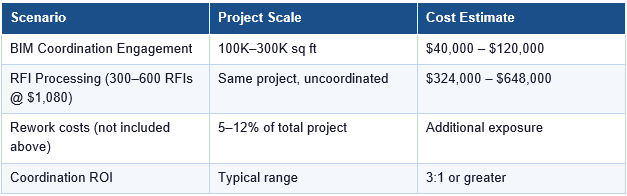
For firms operating on fixed-fee or GMP contracts, this math is not academic. Every RFI your coordination process eliminates is margin protection.
There is also a downstream effect that rarely appears in RFI cost models: subcontractor trust and retention. Trades that repeatedly hit uncoordinated conditions — stop-and-wait cycles, conflicting instructions, field-engineered workarounds — price that risk into future bids. Firms with a reputation for tight coordination drawings attract better subcontractor pricing. The BIM coordination investment compounds across your project portfolio, not just on a single job.
Where US AEC Firms Are Leaving RFI Reduction on the Table
The firms generating the most field RFIs are not ignoring BIM. Most are using Revit. Many are running clash detection. The gap is in execution discipline and QA/QC rigor — not tool access.
Specific failure points that drive preventable RFI volume:
- Clash detection reports are generated but not fully resolved before document issue. Open clashes get marked “for field coordination” — which is industry shorthand for “this will become an RFI.”
- Coordination models are not updated after design changes. A change order or addendum modifies the design, but the coordination model isn’t updated to reflect it. The field encounters the new condition without updated coordination.
- No single point of accountability for coordination sign-off. Multiple disciplines, multiple subcontractors, no structured workflow for confirming that each coordination issue has been resolved and documented.
- QA/QC is treated as a checklist rather than a review process. Reviewing that files were submitted is not the same as reviewing that the content is constructable and coordinated.
A virtual BIM team with embedded QA/QC protocols addresses each of these systematically — not as a project-by-project effort but as a standard workflow. The distinction matters because RFI reduction is not a one-project outcome. It is a process outcome. Firms that reduce RFIs consistently do so because their pre-construction coordination workflow is consistent — not because they got lucky on a single job. That consistency requires structure, accountability, and QA/QC discipline at every coordination milestone, on every project, without exception.
eLogicTech integrates directly into US AEC project workflows as a virtual team extension, providing BIM coordination, MEP modeling, clash detection, and QA/QC review services calibrated to your project type, LOD requirements, and construction timeline.
Our QA/QC process is not a final review step. It is embedded at every coordination milestone — ensuring that what leaves the coordination phase is spatially accurate, discipline-coordinated, and constructable before it reaches your field teams.
Firms working with eLogicTech on coordination packages consistently track measurable RFI reduction on coordinated projects compared to their historical baseline. That reduction is margin. It is schedule. It is the difference between a project that delivers and one that survives.
Running high RFI volumes on current projects?
Talk to eLogicTech about where your pre-construction process is generating preventable field conflicts.
Schedule a Coordination Review →


