

SEO & META INFORMATION
Meta Title: BIM Coordination Failures Cost More Than the Fix | eLogicTech
Meta Description: Most BIM coordination failures don’t start in Navisworks — they start weeks earlier in model setup, discipline handoffs, and undefined workflows. Learn what’s really going wrong before clash detection begins, and how to fix it upstream.
URL Slug: https://www.elogictech.com/blog/bim-coordination-failures-before-clash-detection
Focus Keyword: BIM coordination failures
Estimated Read Time: 6–8 minutes
Primary Keywords:
- BIM coordination failures
- clash detection BIM
- BIM MEP coordination
Secondary Keywords:
- Navisworks clash detection
- BIM coordination workflow
- MEP coordination issues
- BIM model setup errors
- multi-discipline BIM coordination
Long-Tail Keywords:
- what causes BIM clash detection failures
- BIM coordination problems before Navisworks
- how to avoid MEP coordination clashes in BIM
BLOG CONTENT
Introduction
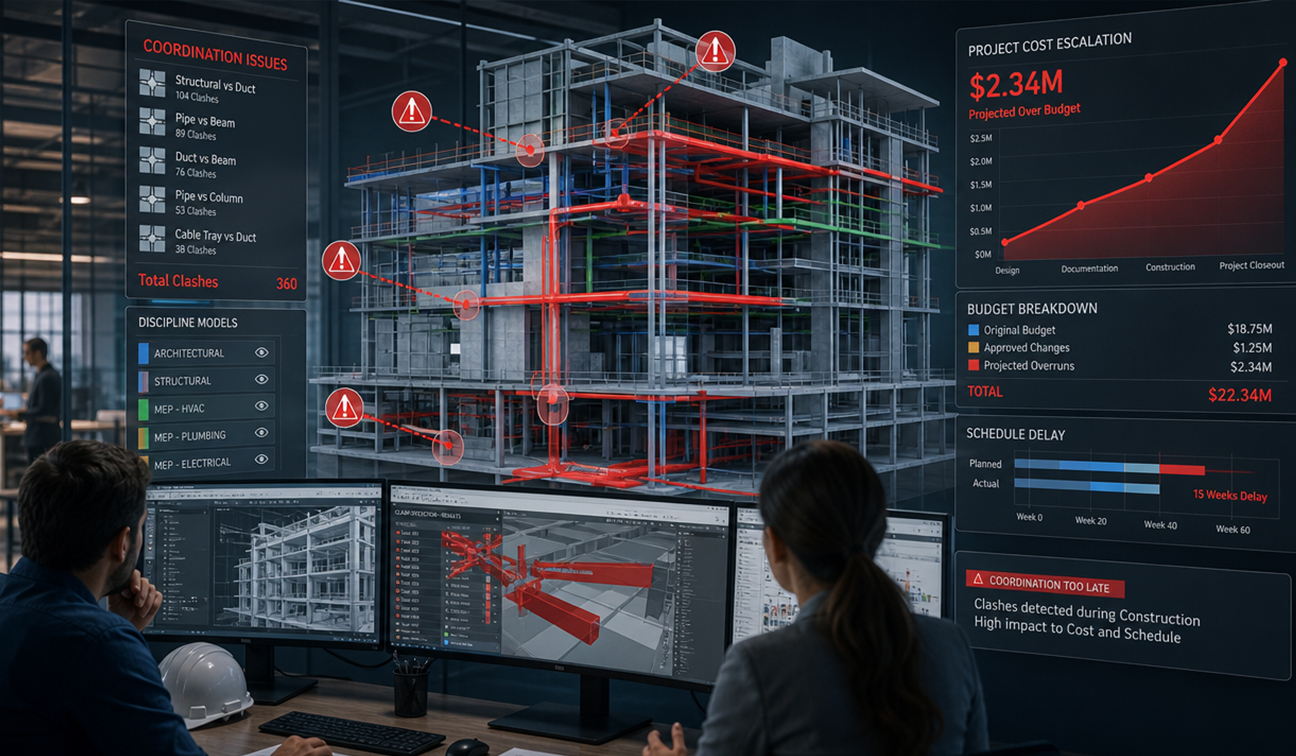
Clash detection gets the blame. But by the time Navisworks generates that 300-clash report, the real damage is already done — to your schedule, your RFI log, and your contractor relationships. The root causes were baked in weeks earlier, and no software tool can undo decisions that were already made upstream.
In this article, we break down exactly where BIM coordination fails before clash detection even begins — and what it’s actually costing your projects.
Clash detection is a diagnostic tool, not a prevention strategy. Teams that treat it as their coordination plan are working backwards. By the time a clash is flagged, two engineers have already modeled conflicting systems, a coordination meeting has been scheduled, and an RFI is waiting to be written.
The real coordination work — the kind that prevents costly rework — happens before the model is ever federated. It happens in kickoff meetings, BIM execution plans, and inter-discipline handoff protocols. Skip those, and Navisworks becomes your project’s crash report instead of its quality checkpoint.
Where Coordination Actually Breaks Down: 5 Upstream Failure Points
1. No Agreed BIM Execution Plan (BEP) Before Modeling Begins
Without a documented BEP, every discipline team makes independent assumptions about LOD, coordinate systems, naming conventions, and handoff schedules. These assumptions don’t converge — they collide. A BEP isn’t a bureaucratic formality; it’s the contract that keeps a federated model from becoming a coordination nightmare.
2. Inconsistent Model Origins and Shared Coordinates
This is one of the most common — and most avoidable — causes of mass clash reports. When architectural, structural, and MEP models are built to different survey points or project base points, the federated model is misaligned before a single system is routed. Every team thinks their model is correct. They’re all right. And none of them work together.
3. Uncoordinated LOD Expectations Across Disciplines
Structural modeling at LOD 350 while MEP is still at LOD 200 creates a false sense of coordination readiness. Structural connections are fully detailed; MEP routing is still schematic. The clash detection run becomes meaningless because the models aren’t at equivalent development stages. Coordination requires parity, not just presence.
4. Discipline Handoffs with No Review Gate
Models passed forward without internal QA bring every modeling error into the coordination environment. Duplicate elements, unconnected systems, incorrect family parameters, and missing clearances get federated into the shared model and generate spurious clashes that bury the real ones. A 3-step internal quality review before any model is shared can eliminate 40–60% of clash report noise.
5. Late MEP Involvement in the Design Process
When MEP engineers join a project after architectural and structural decisions are locked, they’re routing systems through a building that wasn’t designed with their systems in mind. Ceiling heights, beam depths, and shaft locations are already fixed. The result isn’t a coordination problem — it’s a design problem that clash detection can’t solve.
The Real Cost Nobody Calculates
Each unresolved upstream issue multiplies downstream. One missed coordination decision can generate 3–8 clashes. Each clash typically requires an RFI, at least one coordination meeting, and potential field rework. Industry benchmarks place average rework costs at 5–9% of total project value.
That’s not a clash detection problem. That’s a process problem — one that starts weeks before anyone opens Navisworks.
What a Proactive Coordination Workflow Looks Like
The correct sequence is:
- BIM Execution Plan — agreed LOD, coordinates, naming, handoff schedule
- Model Standards Alignment — shared coordinates confirmed across all disciplines
- Discipline Modeling — parallel development with defined LOD milestones
- Internal QA Per Discipline — model review before federation
- Federated Model Review — coordination meetings with discipline leads
- Clash Detection — confirmation of coordination quality, not discovery of problems
With 25 years in AEC and deep experience in multi-discipline BIM coordination, eLogicTech embeds coordination discipline from project kickoff — not after the clash report lands. Our QCare 3-step quality process ensures every model is clean and compliant before it reaches the coordination table.
We work in Autodesk Revit and Navisworks with Architecture, Structural, and MEP disciplines. Our coordination team doesn’t just run clash reports — we establish the upstream process that makes those reports short.