


Introduction
The budget conversation on most AEC projects follows a predictable pattern. The model is built in 3D. The estimator exports quantities from the model — or worse, scales off drawings manually — and rebuilds the takeoff in a spreadsheet. The spreadsheet and the model drift apart from the moment the first design change happens. By the time construction starts, the cost data is chasing the model instead of coming from it.
This is a 3D BIM problem on a project that should be running 5D.
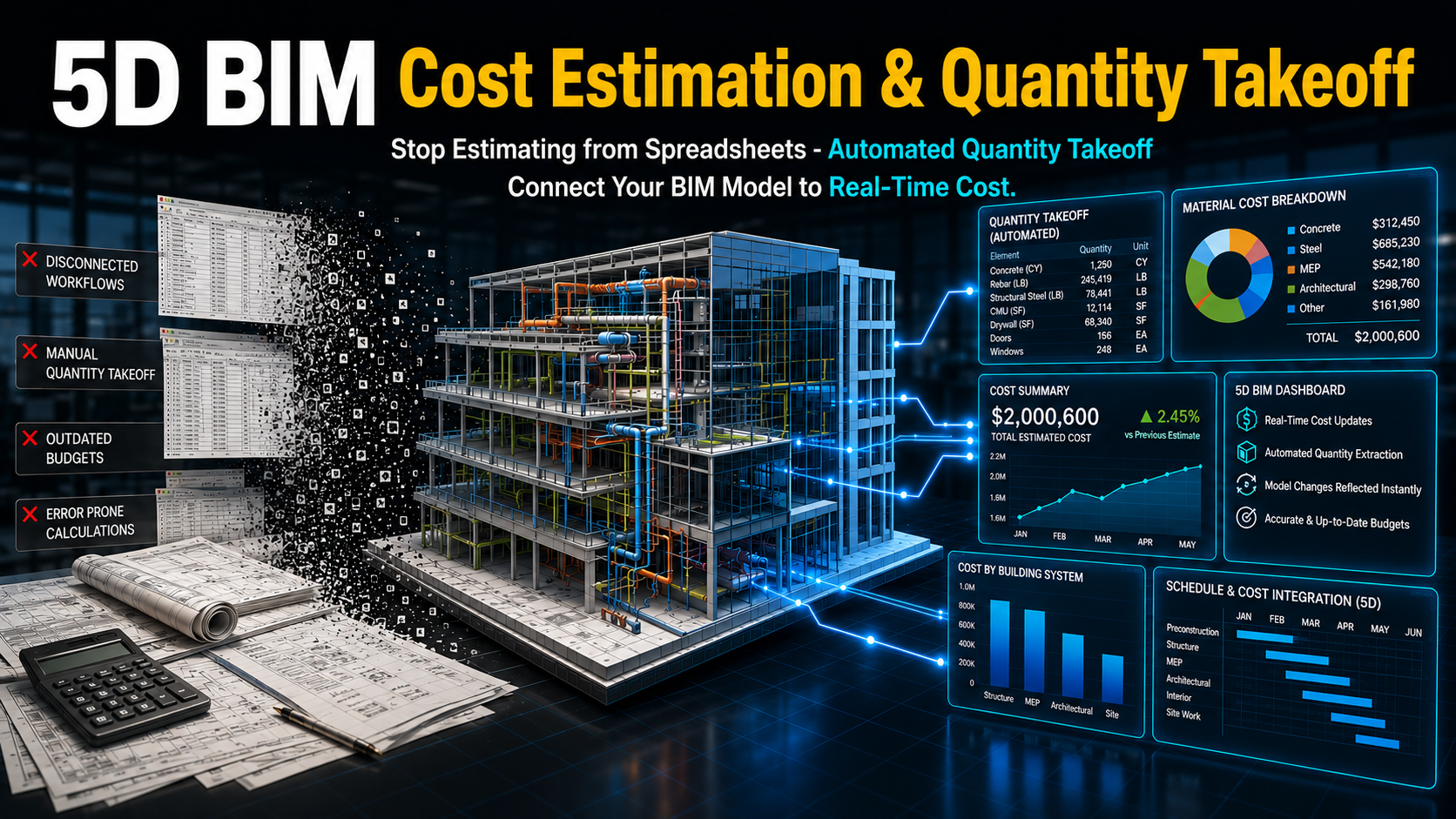
5D BIM connects the model directly to cost. Quantities flow from the BIM model into the estimate. When the design changes, the quantities update. When the quantities update, the cost reflects reality. The spreadsheet doesn’t disappear — but it stops being a disconnected parallel process and becomes an output of the model instead of a replacement for it.
Most US AEC firms know this exists. Most haven’t implemented it. This blog breaks down exactly what 5D BIM is, why the gap between knowing and doing is so wide, and what firms that have closed that gap are actually experiencing.
The BIM Dimensions, Defined Clearly
The ‘dimensions’ of BIM are often thrown around without clear definitions. Here’s what they actually mean:
- 3D BIM — The geometric model. Spatial relationships, component data, clash detection. What most firms mean when they say ‘we use BIM.’
- 4D BIM — The 3D model linked to time. Construction sequencing, schedule visualization, phasing logic. The model shows what gets built when.
- 5D BIM — The 3D model linked to cost. Model elements carry quantity data that feeds directly into cost estimation and budget tracking. The model shows what gets built, when, and what it costs.
- 6D BIM — Sustainability and energy performance integrated into the model.
- 7D BIM — Facility management and lifecycle asset data.
The jump from 3D to 5D is where the largest untapped commercial value sits for most US AEC firms. 4D is increasingly common on complex projects. 5D remains the exception — not because the technology isn’t available, but because the workflow change is significant and the organizational resistance is real.
What 5D BIM Actually Changes in the Estimating Workflow
Traditional quantity takeoff is labor-intensive, error-prone, and disconnected from the design model by default. An estimator works from drawings — either manually measuring or using takeoff software — to build a quantity list that is then priced. When the architect issues a revision, the estimator has to find every affected quantity and update the spreadsheet manually. On a complex project, a single design iteration can take days of re-work in the estimate.
5D BIM restructures this entirely:
Model Elements Carry Quantity Data by Default
In a properly structured 5D BIM workflow, every element in the model — every wall, slab, beam, duct run, pipe segment, light fixture — carries the quantity data needed for estimation: area, volume, length, count, material type. This data isn’t added after the fact. It’s embedded in the element as part of how it’s modeled.
Quantities Extract Automatically and Update With the Model
When the model changes — a wall moves, a floor plate grows, a MEP system is rerouted — the quantities update automatically. The estimator isn’t chasing design changes. The cost model reflects the current design state in real time, or as close to it as the model update cycle allows.
Cost Is Applied to Model Elements, Not to Line Items in a Spreadsheet
In a mature 5D workflow, unit costs and labor rates are mapped to model element types. When quantities change, cost changes. The budget doesn’t require manual reconciliation with the design — it is the design, expressed in cost terms. Design decisions become immediately visible as budget impacts, not retrospective surprises.
Why Most US AEC Firms Haven’t Made the Shift
If 5D BIM delivers this much value, why are most US projects still running disconnected takeoffs from a 3D model?
Model Quality Has to Be There First
5D BIM is only as accurate as the model it pulls quantities from. A model with inconsistent element classification, missing parameters, or approximate geometry produces inaccurate quantity takeoffs. Many firms that have tried 5D workflows hit this wall early — the quantities didn’t match the manual takeoff, confidence collapsed, and the team reverted to spreadsheets. The problem wasn’t 5D. It was model quality.
Estimating and Modeling Have Been Separate Disciplines
In most AEC firms, the estimating team and the BIM team operate in different lanes. The estimator doesn’t build the model. The BIM team doesn’t price the job. 5D BIM requires these disciplines to speak the same language — which means either cross-training, workflow restructuring, or bringing in a partner who already bridges both.
The Workflow Change Is Organizational, Not Just Technical
Implementing 5D BIM isn’t a software decision. It’s a process change that affects how design decisions are made, how revisions are managed, how estimates are presented to clients, and how project controls are structured. Firms that treat it as a software upgrade get limited results. Firms that treat it as a workflow transformation get the full return.
What Firms Running 5D BIM Are Actually Experiencing
The outcomes for firms that have implemented 5D BIM workflows consistently track across a few core metrics:
- Faster design-to-estimate cycles — Quantity takeoff that used to take days takes hours when quantities extract from the model. Design iteration speed increases because cost feedback is near-immediate.
- Fewer budget surprises at GMP — When cost tracks with design in real time, the gap between the SD estimate and the GMP is smaller. Owners get fewer ‘value engineering’ crises at 60% CD.
- Stronger client conversations — When a design team can show the budget impact of a material change or a scope addition in the same meeting, that’s a different conversation than ‘we’ll update the estimate and get back to you.’
- Reduced rework in procurement — Accurate model-based quantities reduce the gap between estimated and actual material procurement, which matters on projects running tight schedules and tighter material budgets.
The Model Quality Prerequisite: Why It Starts With the BIM Team
5D BIM lives or dies on model quality. Every quantity extraction is only as reliable as the model element it comes from. This means the BIM production team — the people building and managing the Revit model — has to understand what the cost team needs from the model, and structure their work accordingly.
That means:
- Consistent element categorization that maps to cost codes
- Parameter completeness — material type, finish, specification — embedded at the element level
- Model audit processes that catch classification errors before quantity extraction
- LOD discipline — quantities extracted from an LOD 200 model and priced as LOD 350 is one of the most common sources of 5D failure
A 5D-ready BIM model isn’t just a 3D model with a cost tool pointed at it. It’s a model built from the start with quantity extraction in mind.
eLogicTech delivers BIM 5D Cost Estimation and BIM Quantity Takeoff as dedicated services — built on top of the same high-quality BIM modeling practice we’ve operated for 25 years. Our models are structured for quantity extraction from the start: consistent element classification, complete parameter sets, and a 3-step QCare quality process that catches modeling errors before they corrupt a takeoff.
For firms that already have a model and need quantity takeoff support, we work from your existing Revit files. For firms starting a new project and wanting 5D capability built in from schematic design, we structure the model to serve both coordination and cost from day one.
The firms still running 3D projects and parallel spreadsheets aren’t behind because the technology isn’t ready. They’re behind because the workflow change requires the right production partner. That’s the gap we fill.