


Introduction
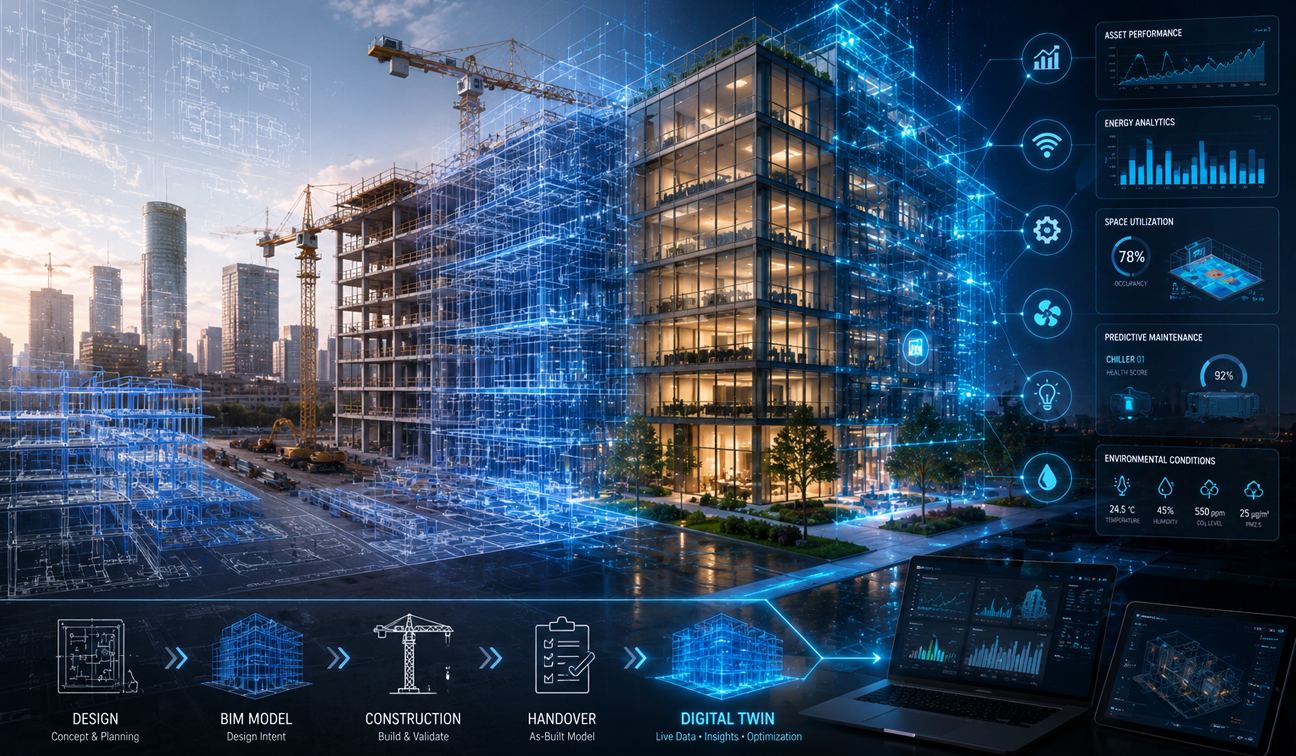
Ask ten AEC professionals what a digital twin is and at least six will describe their BIM model.
That confusion is understandable. A high-quality Revit model is detailed, data-rich, and looks like a precise digital replica of a building. But calling it a digital twin is like calling a photograph a person. The image captures the appearance at one moment in time. It can’t tell you what’s happening inside right now.
The distinction matters commercially. Owners are increasingly asking for digital twin deliverables at project handover. Facility managers are making procurement decisions based on whether design teams can provide a live, connected model — not just a static one. And the AEC firms that understand the gap between a BIM model and a true digital twin are winning that work.
This blog draws that line clearly — what a BIM model is, what a digital twin actually requires, and what the path from one to the other looks like in practice.
What a BIM Model Actually Is
A BIM model is a data-rich 3D representation of a building as it was designed — or as it was built, in the case of as-built models. It contains geometry, component data, system information, material specifications, and spatial relationships. At LOD 400, it’s detailed enough to drive fabrication. At LOD 500, it reflects as-built conditions with verified field dimensions.
A BIM model is a snapshot. An exceptionally accurate, information-dense snapshot — but still a snapshot. It reflects the building as it was at the moment the model was last updated. Once a project is handed over and the building enters operation, that model starts aging immediately. Systems are modified. Equipment is replaced. Spaces are reconfigured. The model stays the same.
That’s not a flaw in BIM. It’s the natural limit of any static model. The question is what happens when the building needs to be actively managed, optimized, and maintained over its full operational life.
What a Digital Twin Actually Requires
A digital twin is a dynamic, continuously updated digital representation of a physical asset — connected to that asset through live data feeds and capable of reflecting its current state, not just its designed or as-built state.
Four things separate a digital twin from a BIM model:
1. Real-Time Data Connection
A digital twin is connected to its physical counterpart through sensors, IoT devices, building management systems (BMS), or other data acquisition infrastructure. It receives live inputs: temperature readings, energy consumption, equipment runtime, occupancy data, air quality metrics. The model updates as the building changes — not when someone manually revises a Revit file.
2. Bidirectional Intelligence
A digital twin doesn’t just receive data — it processes it. A true digital twin can run simulations, generate alerts, predict failures before they occur, and surface operational insights that no static model can provide. When a chiller is trending toward a maintenance event, the twin flags it. When energy consumption deviates from the baseline model, the twin identifies which system is responsible.
3. Lifecycle Continuity
A BIM model’s primary life is the design and construction phase. Its data is most valuable to architects, engineers, and contractors. A digital twin’s primary life begins at handover and extends through the full operational lifespan of the building — which in most cases is 30 to 50 years. That’s where the majority of a building’s lifetime cost occurs, and where a digital twin delivers its highest ROI.
4. Current-State Accuracy vs. Design-Intent Accuracy
A BIM model reflects design intent or as-built conditions at a fixed point in time. A digital twin reflects current conditions — continuously. If a VAV box was replaced with a different model last quarter, the digital twin knows. If a partition wall was added to subdivide an office, the twin reflects it. The static BIM model does not, unless someone manually updates it.
Why the Confusion Is Costing AEC Firms
When design teams promise ‘digital twin deliverables’ at handover and deliver a well-built LOD 400 Revit model, two things happen. First, the owner’s facilities team immediately discovers the model can’t answer the operational questions they were expecting it to answer. Second, the design firm loses the follow-on relationship because they haven’t positioned themselves as the team that can build and maintain the connected twin.
The reverse problem also exists: AEC firms that dismiss digital twins as futurist technology and skip the conversation entirely are losing handover scope and post-construction service revenue to firms that understand what owners actually want when they ask for a ‘living model.’
Getting the definition right isn’t semantic housekeeping. It’s a commercial differentiator.
The Path From BIM Model to Digital Twin: What It Takes
The good news: a high-quality, data-rich BIM model is the best possible starting point for a digital twin. The model provides the geometric and data foundation. What’s needed to activate it as a true twin is a layered technology stack:
- IoT Sensor Infrastructure — Sensors and data acquisition devices installed on critical building systems: HVAC, electrical, plumbing, life safety, and building envelope. These feed live operational data into the digital environment.
- Data Acquisition and Integration Layer — Wireless or wired data collection infrastructure that aggregates sensor data and feeds it into the cloud platform. Automated distributed acquisition removes the need for manual data collection.
- Cloud Platform and Digital Model — A cloud-hosted environment where the BIM model is linked to live data streams. The platform maintains the current-state model, stores historical data, and enables simulation and analysis.
- Analytics and Alerting Engine — The intelligence layer that processes incoming data, identifies deviations from baseline, generates maintenance alerts, and surfaces energy optimization opportunities.
- Stakeholder Dashboards — Role-specific views of the twin’s data: facility managers see equipment health and energy consumption; ownership sees portfolio performance; engineering teams see system-level operational data.
The BIM model is layer zero. Without it, the twin has no geometric or data foundation. With it, the path to a live twin is a technology integration challenge — not a modeling rebuild.
Where eLogicTech Sits in This Stack
eLogicTech delivers both sides of the BIM-to-digital-twin journey. Our BIM team produces accurate, data-rich as-built models — the geometric and information foundation a digital twin requires. Our IoT and Automation practice builds the connected layer: IoT-based digital twin infrastructure, automated distributed and wireless machine and asset data acquisition, energy consumption monitoring, asset condition monitoring, custom cloud platform development, and stakeholder dashboards.
This end-to-end capability is rare in AEC. Most BIM firms stop at model delivery. Most IoT firms don’t understand the BIM model structure that the twin needs to connect to. eLogicTech operates across both domains — which means the handover from static model to live twin doesn’t require a second vendor, a second integration project, or a second learning curve.
With 25 years in AEC and an IoT and Automation practice launched in 2022, we’ve built the capability to deliver a building’s digital life from design through decades of operation.


