


From airports and hospitals to federal infrastructure projects, U.S. owners are demanding ultra-accurate, faster, and metadata-rich Scan-to-BIM deliverables in 2025. Traditional Scan-to-BIM workflows—once considered advanced—are now insufficient for modern construction, asset management, and digital twin requirements.
This shift is being driven by three major forces:
- Stricter Federal & State Requirements for documentation, verification, and digital record submission
- Owner-side digital transformation and rapid adoption of Digital Twins & CDE platforms
- The need for precise as-built data to reduce rework, RFIs, and construction risk
This evolution is what the industry now calls Scan-to-BIM 2.0—a standardized, accuracy-optimized, data-enriched approach that aligns with the new expectations of U.S. owners, design-build firms, and contractors.
The New Accuracy Expectations in 2025 :
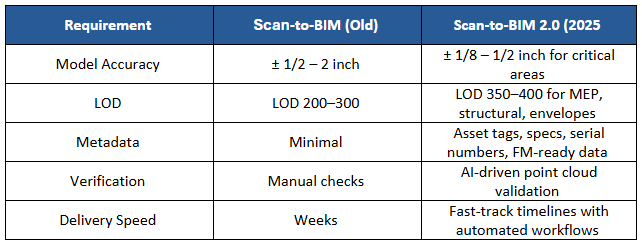
U.S. owners are increasingly specifying tighter tolerances and richer datasets. The standard shift looks like this:
Accuracy Requirements – Old vs New
What Is Scan-to-BIM 2.0? (And Why Owners Prefer It)
Scan-to-BIM 2.0 is a refined workflow that combines:
- High-density LiDAR scanning (SLAM, TLS, drone)
- AI-assisted point cloud cleanup & feature extraction
- Automated geometric modeling and accuracy cross-checking
- LOD-specific as-built modeling tailored to owner use cases
- Metadata-enriched digital assets for maintenance and operations
The goal is not just to recreate geometry—it’s to produce a verified digital replica that supports construction, renovation, asset management, and digital-twin environments.
Key Drivers Behind Increased Accuracy Demands
1. Hospitals & Life Sciences Require Zero-Tolerance Modeling.
Healthcare owners demand pinpoint modeling of MEP, equipment clearances, and life-safety systems, making ± 1/8 – 1/2 inch accuracy essential.
2. Federal Infrastructure Projects Demand Verified As-Builts.
DOT, airport authorities, and federal agencies require digital documentation for lifecycle management, compliance, and capital planning.
3. Digital Twins Need Reliable Ground Truth Data.
Digital twins fail without an accurate spatial foundation. Owners want models ready for IoT integration, predictive maintenance, and operations dashboards.
4. Renovation, Retrofit & Adaptive Reuse Projects Are Rising.
Existing conditions rarely match legacy drawings. Scan-to-BIM 2.0 eliminates risk by digitizing reality with precision.
How eLogicTech Delivers Scan-to-BIM 2.0 Accuracy
eLogicTech has engineered a next-generation workflow specifically optimized for U.S. owner and contractor requirements.
✔ High-Definition Scanning & Point Cloud Processing
We work with LiDAR, photogrammetry, drones, and mobile SLAM devices depending on building complexity and accessibility.
✔ Automated Point Cloud Cleanup & AI-Based Feature Detection
Our AI pipelines remove noise, classify elements, and extract features to accelerate modeling while improving accuracy.
✔ LOD-Tailored Modeling for Purpose-Specific Use Cases
Models are developed according to LOD 300–400, documented in the BEP, and aligned with owner/GC requirements.
✔ Multi-Level Accuracy Validation
We use:
- Cloud-to-cloud deviation heatmaps
- Point-to-model validation checks
- Tolerance-based clash checks
to ensure models meet ± 1/8 – 1/2 inch targets where required.
✔ FM-Ready Data Structuring
We include metadata: manufacturer, capacity, serial numbers, maintenance cycles—making the model ready for facility operations.
4 Practical Use Cases Where Owners Want Scan-to-BIM 2.0
1. Preconstruction & Renovation Planning
Contractors rely on precise as-builts to avoid costly rework during demolition and retrofit stages.
2. MEP Coordination for Congested Spaces
High-accuracy modeling reduces clashes and field conflicts during remodeling or system upgrades.
3. Digital Twin Development
A precise spatial digital foundation allows real-time operational monitoring and lifecycle management.
4. Facility Management Handover
Owners want a single source of truth with searchable asset data embedded in the model.
ROI of Upgrading to Scan-to-BIM 2.0
Owners adopting Scan-to-BIM 2.0 see tangible benefits:
- 30–40% reduction in field rework
- Up to 25% faster renovation design cycles
- 10–20% improvement in MEP routing efficiency
- Faster construction buyout due to verified quantities
- Lifecycle savings from FM-ready datasets
The return on investment is significant, especially for large portfolios.
Why U.S. Owners Choose eLogicTech
eLogicTech stands apart due to:
- Specialized Scan-to-BIM teams for healthcare, airports, retail, industrial, and infrastructure projects
- U.S.-aligned BEP templates, LOD frameworks, and QA/QC standards
- Ability to scale from small remodels to multi-million-square-foot portfolios
- Hybrid onshore–offshore model that balances speed, precision, and cost efficiency
Conclusion
Scan-to-BIM 2.0 isn’t simply a trend—it’s the new standard for U.S. owners who expect verified, precise, and operation-ready as-built models. With construction complexity rising and digital transformation accelerating, accuracy is becoming non-negotiable.
eLogicTech is enabling owners, architects, and contractors to move confidently into this new era with precision modeling, faster delivery, and data-rich digital twins that redefine project certainty.


