


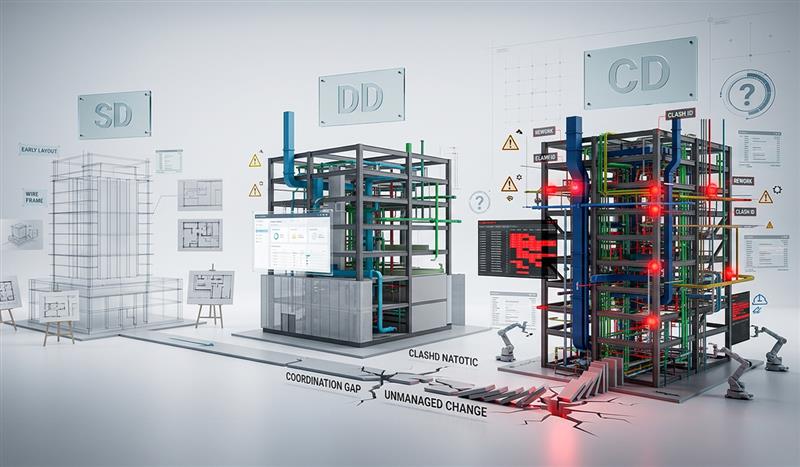
To Prevent Late - Stage Coordination Collapse
Why Phase Gaps Are Quietly Destroying U.S. AEC Project Outcomes
You’ve delivered the construction documents. The permit is in review. And then it happens — a clash between the mechanical ductwork and the structural beams that no one caught. A coordination conflict seeded six months ago in Schematic Design, invisible until now, when fixing it costs ten times more than it would have in week three.
This scenario plays out on job sites and in submittal reviews across the U.S. every day. And in almost every case, the root cause isn’t Construction Documents at all.
Most coordination failures don’t originate in CD. They’re born in SD — and allowed to grow unchecked through DD.
For architecture and engineering firms already operating under staffing shortages, deadline pressure, and tightening margins, late-stage coordination collapse isn’t just a technical inconvenience. It’s a business risk that erodes client confidence, strains internal teams, and quietly shrinks project margins.
This article examines where and why continuity breaks down across design phases — and what firms can do to prevent it.
The Hidden Continuity Problem Across Design Phases
Most firms treat SD, DD, and CD as sequential milestones. In reality, they function as a single, continuous information ecosystem. When handoffs between phases are informal, assumptions go undocumented, and modeling standards shift with team composition, the damage compounds quietly until it can no longer be ignored.
Phase 1: Schematic Design (SD) — Where Future Risk Is Seeded
Schematic Design establishes the spatial DNA of a project: program relationships, massing logic, core system pathways. Done well, it creates a reliable foundation for every downstream decision. Done carelessly, it plants the seeds of coordination chaos.
The problem is that SD is frequently treated as a storytelling phase rather than a coordination baseline. Models are polished for client presentations but lack the data integrity needed to guide downstream teams. MEP and structural placeholders are rough approximations. Naming conventions are inconsistent. Critical assumptions — ceiling heights, shaft locations, equipment clearances — are held informally in the project manager’s head rather than documented in the model.
Common SD Failures
Presentation-optimized models with weak data structure • Undocumented system assumptions • Loosely enforced modeling standards • MEP and structural placeholders lacking spatial accuracy.
When DD teams inherit a loosely structured SD model, they don’t build on it — they reconstruct it. Cycles intended for design development get consumed by forensic interpretation of prior work. The project starts behind before it has truly begun.
Phase 2: Design Development (DD) — Where Coordination Density Accelerates
DD is where the project gets real. System-level detailing begins. Discipline ownership sharpens. Equipment gets sized. Routing decisions get made. And if SD continuity was weak, DD is where the debt starts accruing interest.
Spatial clashes multiply as models grow denser. Revisions cascade across disciplines. Model versions diverge as teams work in parallel without unified governance. RFIs that should surface in consultant coordination meetings start circulating internally instead — burning hours that weren’t budgeted.
The typical response? Overtime and heroics. But bandwidth is not a solution to structural workflow misalignment. It’s a short-term patch that amplifies fatigue, accelerates error rates, and defers the underlying problem into CD — where resolution is far more expensive.
Phase 3: Construction Documentation (CD) — Where Failures Surface Publicly
CD demands precision at scale: cross-discipline synchronization, code compliance integration, sheet-level clarity, and QA/QC rigor — all under deadline pressure. It’s the worst possible phase to discover that your foundation has cracks.
Yet that’s exactly what happens when SD and DD continuity has been weak. Unresolved misalignments become documentation conflicts. Annotation inconsistencies create field confusion. Clash detection shifts from a preventive discipline to a reactive scramble. QA/QC windows compress as submission dates approach.
The downstream effects are predictable: rework cycles, permit delays, change orders, field coordination RFIs, and the slow erosion of client confidence that is difficult to rebuild, even after the project delivers.
Late-stage coordination collapse is not a CD problem. It is a continuity failure across SD → DD → CD.
Why U.S. Firms Struggle to Maintain Phase Continuity
The operational context facing U.S. AEC firms in 2026 makes continuity genuinely difficult. These aren’t excuses — they’re real structural pressures that compound each other:
Staffing Instability
Project phases frequently transition between different internal teams, or absorb new hires mid-stream. Knowledge transfer becomes informal. New team members model from assumption rather than documented intent, introducing interpretation gaps that only surface later.
Deadline Compression
Design timelines shrink. Deliverable expectations don’t. Under pressure, teams prioritize visible output — drawings that look complete — over the structured coordination frameworks that make those drawings reliable.
Hiring Risk and Skill Gaps
Recruiting experienced BIM staff is expensive, slow, and increasingly competitive. Firms rely on mixed-skill teams, which increases modeling inconsistency and makes unified workflow governance harder to enforce.
Tool Fragmentation
Architectural, structural, and MEP disciplines often operate in parallel environments without shared naming conventions, model governance, or clash detection cadence. Coordination becomes reactive rather than embedded.
Fear of Losing Control Mid-Project
Even when coordination strain is evident, many project leaders hesitate to introduce external support mid-stream, worried about handoff friction or loss of design control. The result is a team that continues to absorb compounding risk rather than addressing it.
The Business Impact of Continuity Breakdown
When SD → DD → CD continuity collapses, the consequences extend well beyond the technical. They affect every layer of a firm’s operations:
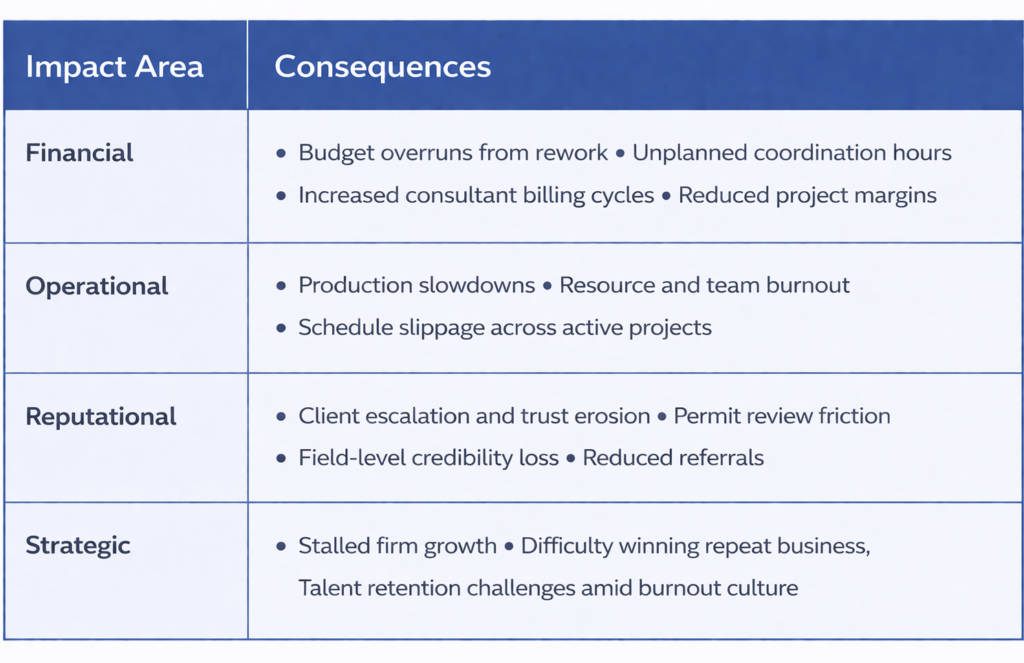
These risks compound across multi-project portfolios. A firm absorbing one late-stage coordination collapse might recover. A firm experiencing it on three simultaneous projects faces a fundamentally different risk profile.
How Structured Phase Continuity Prevents Coordination Collapse
Preventing late-stage failure requires a shift in how design phases are conceived — not as sequential deliverables, but as stages in a single, continuous information ecosystem. Each phase must be structured to support the next.
That means five core practices:
1. Model Governance from Day One
Consistent modeling standards, naming protocols, and data structuring must be established in SD — not retrofitted in DD. When every discipline operates within a shared governance framework from the outset, interpretive gaps are prevented rather than managed.
2. Cross-Phase Information Mapping
Design intent, system assumptions, placeholder logic, and key decisions must be documented and carried forward. DD teams should build on SD work, not reconstruct it. This requires deliberate handoff documentation, not just model file transfers.
3. Discipline-Synchronized Workflows
Architectural, structural, and MEP models must evolve in parallel rather than sequentially. Coordination isn’t a phase-end activity — it’s an embedded, continuous practice that catches conflicts while they’re still inexpensive to resolve.
4. Embedded QA/QC Checkpoints
Quality verification must occur at every phase transition — not only before CD submission. Checkpoint reviews after SD, at mid-DD, and before the DD–CD handoff create structured opportunities to resolve conflicts before they compound.
5. Production Scalability Without Hiring Delays
Coordination intensity peaks are predictable. Firms need flexible production capacity that can scale with project demands — allowing internal teams to maintain documentation momentum without the lag of traditional hiring cycles.
How eLogicTech Enables SD → DD → CD Continuity
eLogicTech operates as a virtual extension of in-house BIM and CAD teams, supporting U.S. AEC firms in maintaining uninterrupted design-to-documentation workflows across all three phases.
Rather than entering at isolated project phases, eLogicTech integrates into active project ecosystems to preserve continuity through every transition. The approach is designed around how projects actually work — not how they look on a project schedule.
What Integration Looks Like in Practice
A mid-size architecture firm is eight weeks into DD on a 180,000 SF mixed-use project. Coordination strain is building: the MEP model has diverged from the architectural baseline, two senior BIM staff have rolled off, and the CD deadline is fixed. Rather than absorbing the risk internally, the firm engages eLogicTech to stabilize the model, re-synchronize discipline workflows, and carry documentation through CD submission — without disrupting the internal team’s design leadership.
Structured Support Includes:
• Phase-Aligned BIM Production — Models evolve consistently from SD through CD without rework-heavy handoffs or knowledge loss at transition points.
• Discipline-Integrated Coordination — Architectural, structural, and MEP workflows operate within unified frameworks that reduce downstream conflicts and keep clash detection preventive.
• Embedded QA/QC Frameworks — Multi-stage quality checkpoints are built into the workflow, not added at the end, preventing error propagation between phases.
• Documentation Scalability — Firms expand production capacity during peak coordination loads without the delays and overhead of traditional hiring.
• Workflow Alignment — eLogicTech adapts to existing U.S. project standards, software environments, and delivery schedules — reducing onboarding friction and preserving internal processes.
This approach reduces coordination risk while allowing internal teams to retain full design leadership and client relationships.
What Continuity Looks Like When It Works
When SD → DD → CD continuity is structured correctly, the project experience changes in measurable ways:
• SD models transition into DD without spatial reinterpretation or assumption-based rebuilding
• DD detailing flows into CD documentation without annotation conflicts or sheet-level surprises
• Clash detection becomes preventive rather than corrective, catching conflicts at hours of cost rather than weeks
• RFI volume reduces before reaching construction teams, not after
• QA/QC windows expand instead of compress as deadlines approach
• Internal teams operate with predictable workloads rather than heroic end-of-phase sprints
Continuity doesn’t eliminate the complexity of large-scale projects. It transforms coordination from a reactive crisis management exercise into a controlled, predictable process.
A Strategic Shift for Growth-Focused AEC Firms
As U.S. projects grow more complex, timelines tighten, and client expectations rise, phase continuity is no longer an operational preference. It’s a competitive differentiator.
Firms that treat SD, DD, and CD as connected operational layers — with shared governance, documented handoffs, and scalable production capacity — achieve something their competitors increasingly cannot: predictable delivery.
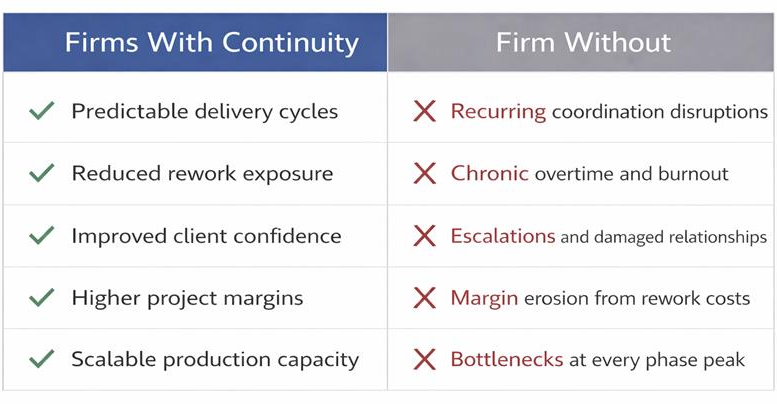
Final Takeaway
Late-stage coordination collapse is not caused by project complexity.
It is caused by disconnected phase workflows — by the accumulation of undocumented assumptions, informal handoffs, and inconsistent modeling governance that compound silently from SD through DD until they become visible, expensive problems in CD.
Structuring SD → DD → CD continuity turns fragmented production into an integrated delivery system — reducing risk, protecting schedules, and strengthening project outcomes.
Ready to strengthen your SD → DD → CD continuity?
Connect with eLogicTech to explore how structured phase support can reduce coordination risk on your next project.


