


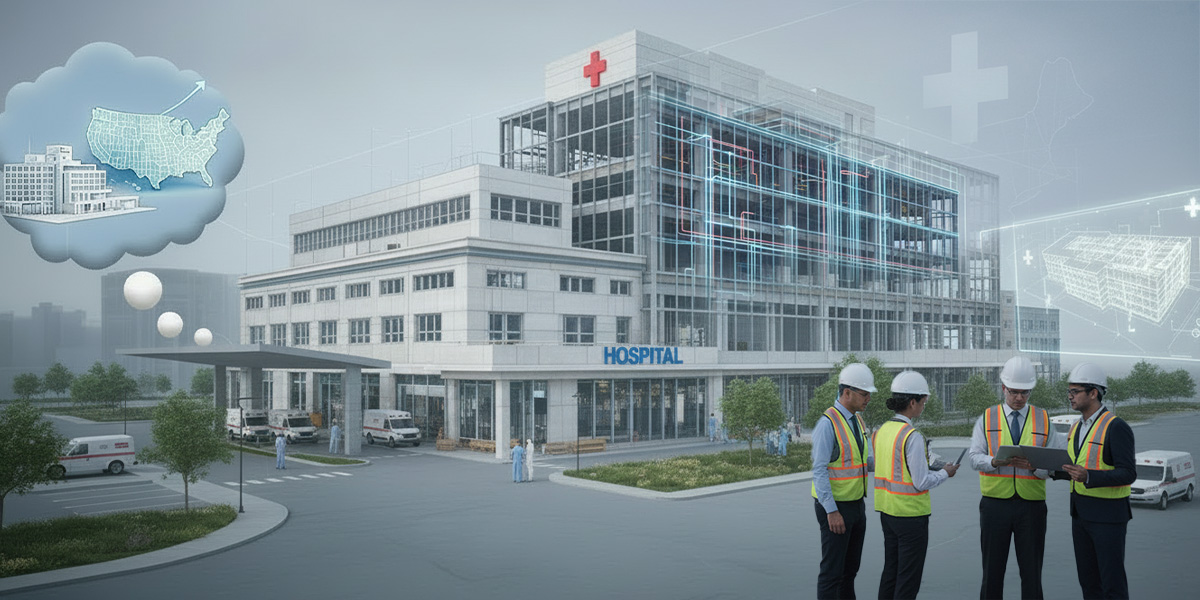
From new hospitals and outpatient clinics to complex retrofits and medical campuses, the U.S. healthcare sector is undergoing its largest construction boom in two decades. Aging infrastructure, population growth, digital health expansion, and federal incentives are driving billions into healthcare facilities.
Amid this surge, Building Information Modeling (BIM) has become mission-critical. Unlike commercial or residential projects, healthcare construction demands extreme precision, regulatory compliance, and seamless MEP coordination—making BIM indispensable for every stage from planning to lifecycle operations.
Between 2025 and 2030, BIM-enabled delivery will shift from optional to mandatory across the U.S. healthcare ecosystem.
Why Healthcare Facilities Need BIM More Than Any Other Sector
Healthcare buildings are uniquely complex environments with:
- Thousands of interconnected medical, mechanical, and life-safety systems
- High-density MEP spaces with zero tolerance for coordination errors
- Strict compliance with FGI, NFPA, ASHRAE, ADA, and state health codes
- Operational demands requiring 24/7 uptime
- Rapid technology changes that require future-ready infrastructure
This complexity makes traditional CAD or 2D-driven workflows risky and outdated. BIM solves these challenges with precision, predictability, and data richness.
2025–2030 Market Outlook: How BIM Will Drive the Healthcare Construction Boom
1. Surge in New Hospitals & Specialty Centers
U.S. states like Texas, Florida, California, and North Carolina are seeing unprecedented hospital expansion. BIM enables large healthcare systems to:
- Standardize design
- Reduce change orders
- Maintain consistent facility templates
- Scale multi-location building programs
2. Modernization of Aging Facilities
40%+ of U.S. hospitals are over 40 years old. BIM-supported renovation planning is essential for:
- Existing-condition modeling
- Operational sequencing
- MEP upgrades without disrupting operations
3. Transition to Smart & Digital Hospitals
By 2030, U.S. hospitals are projected to double their smart infrastructure investments. BIM enables:
- Digital Twins
- IoT integration
- Predictive maintenance
- Real-time asset management
4. Growth of Outpatient & Ambulatory Care Facilities
Healthcare shifts toward outpatient care, driving demand for smaller, faster, standardized building programs—perfectly suited for BIM-based modular and prefab workflows.
How BIM Adds Value at Every Stage of Healthcare Construction
1. Pre-Design & Planning
BIM supports:
- Early space planning and bed capacity analysis
- Code-based room sizing
- Equipment planning with exact specifications
Healthcare planners use BIM for early feasibility modeling and compliance alignment.
2. Design Development
BIM’s role includes:
- Architectural + MEPFS coordination
- Medical equipment modelling with clearance zones
- Patient flow optimization
- Infection control design review
Multi-disciplinary teams align faster and more accurately.
3. Construction & Prefabrication
BIM enables:
- 4D sequencing for phasing around active hospital operations
- Prefabrication of MEP racks, headwalls, bathrooms, modular exam rooms
- Clash detection to eliminate field conflicts
- Accurate quantity takeoff to control cost overruns
Prefabrication alone reduces schedules by 20–30%.
4. Commissioning & Handover
Healthcare facilities require deep operational data. BIM provides:
- Room-level asset metadata
- Equipment warranty + maintenance cycles
- Digital O&M handover packages
- Integrated commissioning models
Owners receive a digital-first handover, not binders and PDFs.
5. Facility Management & Digital Twins
By 2030, most new U.S. hospitals will operate using Digital Twins.
BIM enables:
- Real-time energy monitoring
- Predictive maintenance via IoT sensors
- Emergency response simulation
- Space utilization analytics
- Asset lifecycle planning
This reduces operational costs by 10–20% annually.
Challenges in U.S. Healthcare Construction—and How BIM Solves Them
1. Highly Congested MEP Systems
BIM supports precise MEP coordination to eliminate clearance issues and ensure life-safety compliance.
2. Strict Regulatory Environment
BIM allows teams to validate:
- FGI guidelines
- NFPA fire protection codes
- ASHRAE ventilation requirements
- ADA accessibility
Directly against model data.
3. Risk of Operational Downtime
For renovations, BIM-based 4D planning ensures zero disruption to clinical services.
4. Equipment-Heavy Spaces
MRI suites, surgery rooms, and ICUs require precise modeling of equipment, shielding, radii, and movement paths.
5. Rising Costs and Labor Shortages
BIM enables prefabrication, automation, and clash-free workflows that reduce manpower dependency.
How eLogicTech Supports U.S. Healthcare Projects With Advanced BIM Solutions
eLogicTech has extensive experience working with hospitals, healthcare systems, MEP contractors, and design teams to deliver high-precision BIM for complex medical environments.
Our Healthcare BIM Capabilities Include:
- Detailed Scan-to-BIM for existing hospitals
- Architecture, Structure, MEPFS BIM at LOD 300–450
- Medical equipment modeling with clearance zones
- Fire and life-safety BIM
- Prefabrication-ready MEP modeling
- 4D & 5D scheduling for phased construction
- Digital Twin–ready BIM models
- FM-ready asset tagging
Why U.S. Healthcare Owners Choose eLogicTech
- Deep familiarity with U.S. healthcare codes and compliance workflows
- Ability to scale quickly for large multi-site rollouts
- Fast-paced turnaround with QA/QC protocols
- Hybrid onshore–offshore model for cost and delivery advantage
- Experience in hospitals, clinics, labs, and life-science facilities
2025–2030: What’s Next for BIM in Healthcare?
The next five years will reshape healthcare construction through:
- AI-powered design automation
- Robotics + BIM-integrated construction
- Digital Twins becoming the operational standard
- Predictive BIM for cost, energy, and space analytics
- Prefabrication-driven hospital expansion models
Healthcare owners will increasingly expect BIM-enabled delivery across every project phase, making digital maturity a competitive necessity.
Conclusion
The U.S. healthcare construction boom represents an unparalleled opportunity—and BIM is at the center of it. Between 2025 and 2030, healthcare facilities will rely on BIM not just for coordination, but for operational intelligence, compliance, and long-term asset performance.
With its proven expertise and healthcare-specific workflows, eLogicTech is empowering architects, contractors, and healthcare owners to deliver safer, smarter, and more efficient medical environments built for the future.


