



Why Capacity Planning Becomes Critical as Q2 Project Load Accelerates
It’s the first week of April. Three DD packages are pushing toward CD. A fourth project just cleared funding approval and needs to mobilize within two weeks. Two of your senior BIM staff are already at capacity. The hiring pipeline you activated in February has produced one strong candidate — who won’t be onboarded and productive for another six weeks.
This is Q2. Not as it appears on a project schedule — as a clean progression of milestones — but as it actually lands on production teams: simultaneous, accelerating, and unforgiving of capacity gaps that were invisible in January.
Q2 doesn’t create capacity problems. It exposes them — at the worst possible moment.
For U.S. architecture and engineering firms, the second quarter is where project momentum peaks and where the gap between delivery ambition and production reality becomes impossible to ignore. DD packages move toward CD. Infrastructure and renovation projects accelerate with the construction season. Client expectations tighten. And the internal staffing model — built for steady-state operations — buckles under the load.
The issue isn’t talent. Most AEC firms have skilled people. The issue is capacity predictability: the ability to maintain consistent production velocity regardless of how fast project demand accelerates.
The Real Capacity Problem AEC Leaders Face
When firm leaders talk about capacity, they usually mean headcount. But headcount is only one dimension of a more complex problem. Predictable delivery actually requires three aligned layers to function simultaneously — and when any one of them breaks, the entire delivery system degrades.
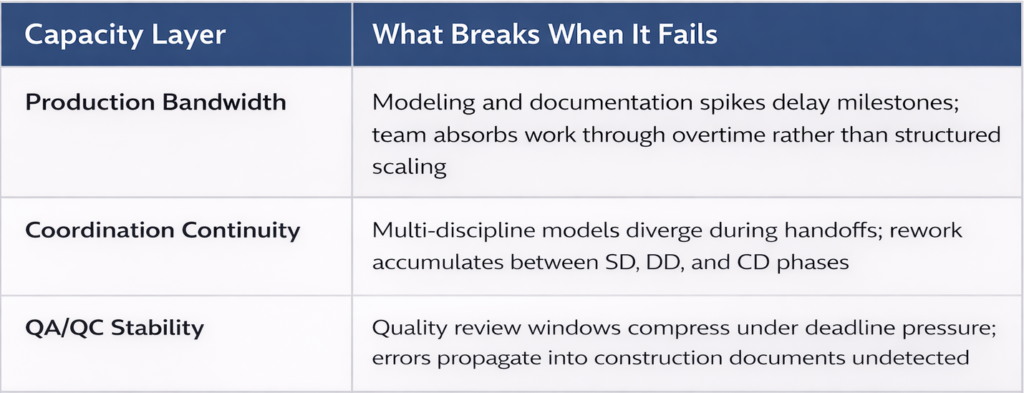
The compounding effect is what makes Q2 particularly dangerous. Deadline compression, internal coordination conflicts, rising RFI volumes, and burnout-driven attrition don’t arrive sequentially. They arrive together, amplifying each other at precisely the moment when production demand peaks.
A pattern that repeats across firms
A 45-person AEC firm entering Q2 with four concurrent active projects finds that their two most experienced BIM coordinators are each carrying more than 110% of their standard project load. QA/QC reviews begin slipping. Clash detection becomes reactive. By mid-May, the firm is managing three simultaneous rework cycles across different projects — not because the team lacked skill, but because the capacity structure was never built to handle peak concurrency.
Why Traditional Hiring Cannot Solve Q2 Capacity Risk
The conventional response to a capacity gap is a job posting. And for long-term growth, strategic hiring is essential. But as a solution to Q2 production pressure, traditional hiring introduces more friction than it resolves.
Consider the timeline: a typical BIM coordinator hire takes four to eight weeks to recruit, another two to four weeks to onboard, and another four to six weeks to reach genuine project productivity within a firm’s specific standards and workflows. By the time a new hire is truly contributing, the Q2 peak has already passed — and the firm has acquired a permanent overhead commitment sized for a temporary demand spike.
Beyond timeline friction, hiring introduces three structural risks that are rarely acknowledged in the capacity planning conversation:
Fixed Overhead Against Variable Demand
Project load is inherently cyclical. Permanent headcount additions increase fixed cost structures that must be carried through lower-demand quarters, directly compressing margins during periods when revenue is thinner.
Skill Mismatch at the Moment of Need
Peak-load demand is rarely uniform. One quarter may require deep Revit MEP coordination expertise; another may demand accelerated CD documentation throughput. Generalist hires rarely match the specific specialization that peak-load projects actually require.
Modeling Inconsistency From Mid-Project Integration
Adding new internal staff mid-project is operationally disruptive. Naming conventions, modeling standards, coordination protocols, and file structures require intensive familiarization — and the inconsistencies introduced during that ramp-up period create downstream documentation conflicts that surface at the worst possible time.
Hiring is a long-term investment. It is not a Q2 capacity solution.
The Strategic Shift: From Hiring-Based Scaling to Capacity-On-Demand
The firms navigating Q2 most effectively have made a fundamental reframe in how they think about production capacity. They’ve stopped asking “How many people do we need to hire?” and started asking “How do we maintain consistent production velocity without expanding permanent overhead?
This shift leads directly to the Virtual BIM Team Model — a structured delivery framework where external BIM specialists operate as an integrated extension of in-house teams, aligned to existing standards, tools, and workflows from day one.
The distinction from traditional outsourcing is important and worth stating clearly. Conventional outsourcing is typically task-based: you send work out, you receive deliverables back. The Virtual BIM Team Model is process-based: external specialists operate inside your project environment, within your coordination protocols, under your QA/QC standards, as a functional extension of your internal team — not a parallel track running alongside it.
What integration actually looks like
A 60-person architecture firm approaching Q2 with five concurrent projects engages a virtual BIM team three weeks before peak load arrives. The external team is onboarded to the firm’s Revit standards and BIM Execution Plan, integrated into the coordination workflow for two active DD packages, and operational within four business days. When the fifth project mobilizes two weeks later, capacity is already in place — no hiring lag, no modeling inconsistency, no disruption to the internal team’s design leadership.
How the Virtual BIM Team Model Enables Predictable Q2 Capacity
The model works because it addresses all three capacity layers simultaneously — not just headcount.
Immediate Production Scalability
Additional modeling and documentation capacity becomes available on a timeline measured in days, not months. Firms can mobilize additional production support before peak strain arrives rather than after it’s already compressing delivery.
Workflow-Aligned Integration
External teams operate within established project environments — firm-specific BIM standards, naming conventions, file structures, and coordination protocols. Continuity across SD → DD → CD phases is preserved rather than disrupted by new team members who are learning the firm’s working methods under deadline pressure.
Multi-Discipline Coordination Support
Architectural, structural, and MEP modeling can evolve in synchronized workflows rather than sequential handoffs. Clash detection remains preventive rather than reactive. RFI volumes reduce before they reach construction teams rather than after.
Embedded QA/QC Protocols
Structured quality frameworks are built into the delivery process, not added at the end. Multi-stage model reviews, coordination checks, and documentation audits prevent error propagation between phases — preserving the QA/QC windows that are the first casualty of capacity-strained delivery.
Flexible Engagement Structures
Firms scale capacity up or down based on project intensity. When Q2 peak passes, engagement scales back. There is no permanent overhead commitment, no annual salary burden, and no difficult staffing conversation when workload normalizes.
Addressing What Firms Actually Worry About
The Virtual BIM Team Model is not universally adopted — not because it doesn’t work, but because leadership teams have legitimate questions about how it works in practice. These concerns deserve direct, substantive answers.
“We’ll lose control of our models and design intent.”
Control of design authority never transfers. Internal project leads retain full ownership of design decisions, coordination strategy, and client communication. The virtual team operates within the coordination protocols the firm defines — executing production work, not making design judgments. Think of it as expanding your production layer, not your leadership layer.
“Quality will decline when work leaves the building.”
This concern conflates location with process. Quality is a function of standards, oversight, and embedded QA/QC frameworks — not physical proximity. A virtual team operating within structured quality protocols and regular coordination checkpoints consistently outperforms an overstretched internal team running on overtime without review windows.
“Communication overhead will slow us down.”
Poorly structured virtual teams do create communication overhead. Well-structured ones don’t. The key is integration cadence: defined coordination cycles, shared collaboration environments, and clear escalation paths. When these are established at onboarding, communication becomes a workflow feature rather than a friction point.
“Data security is a real concern for our clients.”
It is, and it should be treated as a non-negotiable requirement rather than a general concern. Secure access protocols, controlled project environments, NDA frameworks, and data handling agreements should be explicit, documented conditions of any virtual team engagement — not assumed assurances.
Why Q2 Is the Right Time to Adopt Capacity-On-Demand
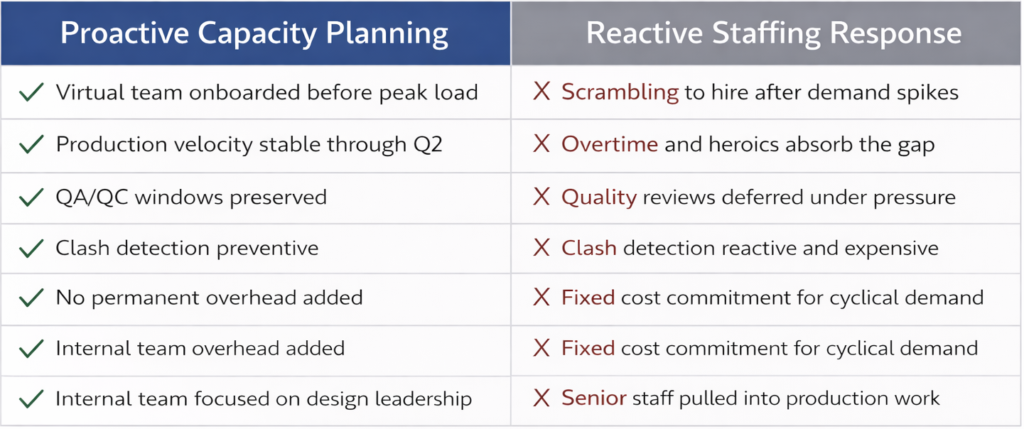
There’s a timing logic to this that matters. Firms that engage virtual BIM support reactively — after peak strain has already arrived — spend the first two weeks of the engagement in stabilization mode rather than production mode. The coordination debt has already accumulated. The rework cycles are already in motion.
Firms that engage proactively — before Q2 pressure compounds — arrive at peak load with capacity already in place, standards already aligned, and production velocity already established. The difference in outcomes is significant.
eLogicTech functions as a virtual extension of in-house BIM and CAD teams — not as a task-based outsourcing vendor, but as a structured delivery partner that integrates into active project ecosystems.
The distinction matters operationally. eLogicTech doesn’t receive file exports and return deliverables. The team operates inside client project environments, within firm-specific BIM standards and coordination frameworks, across the full SD → DD → CD continuum.
For U.S. AEC firms entering Q2, this means:
• Production capacity that can be mobilized in days, not weeks — aligned to your project schedule, not a hiring timeline
• Discipline-integrated delivery across architectural, structural, and MEP workflows within unified coordination environments
• Multi-stage QA/QC frameworks embedded in every phase — protecting documentation quality under deadline pressure
• Full adaptation to firm-specific standards, file structures, software environments, and client delivery protocols
• Flexible engagement scaling that expands with Q2 peak load and contracts as project intensity normalizes — no permanent overhead
Internal teams retain design leadership, client relationships, and coordination authority. eLogicTech carries the production load that would otherwise fall on your most experienced staff at the moment they can least afford to absorb it.
What Predictable Capacity Actually Enables
The firms that structure Q2 capacity correctly don’t just survive the quarter. They use it as a competitive advantage.
While competitors are absorbing coordination failures and rework cycles, firms with predictable capacity frameworks are delivering on schedule, maintaining quality standards, and building the client confidence that drives repeat engagement and referrals.
Operationally, predictable capacity produces a specific set of outcomes that compound over time:
• Stable documentation throughput across concurrent projects, regardless of peak load
• Reduced rework exposure from preventive coordination and embedded QA/QC
• Preserved quality review windows that protect permit submissions and client deliverables
• Lower burnout risk for senior staff who remain focused on design leadership rather than production volume
• Improved schedule confidence that allows firm leaders to commit to delivery timelines without internal uncertainty
• Stronger client delivery assurance that converts single-project engagements into long-term firm relationships
These outcomes don’t require a structural transformation of how the firm operates. They require a structural shift in how the firm thinks about capacity — from a fixed, hiring-based resource to a flexible, on-demand production layer.
Final Perspective
Q2 is a stress test that every U.S. AEC firm faces. The firms that pass it consistently aren’t necessarily larger, better-funded, or more talented than the ones that don’t.
They’re structured differently. They’ve separated capacity planning from hiring cycles. They’ve built production scalability into their operational model rather than treating it as a staffing emergency. And they’ve learned that the question isn’t whether Q2 will accelerate demand — it always does.
The question is whether your capacity framework is built to absorb that acceleration without breaking.
Firms adopting virtual BIM team frameworks gain scalable production power without sacrificing control, quality, or workflow stability — entering Q2 in control, not catching up.
Ready to enter Q2 with predictable capacity?
Connect with eLogicTech to explore how the Virtual BIM Team Model can stabilize your Q2 production before peak load arrives.