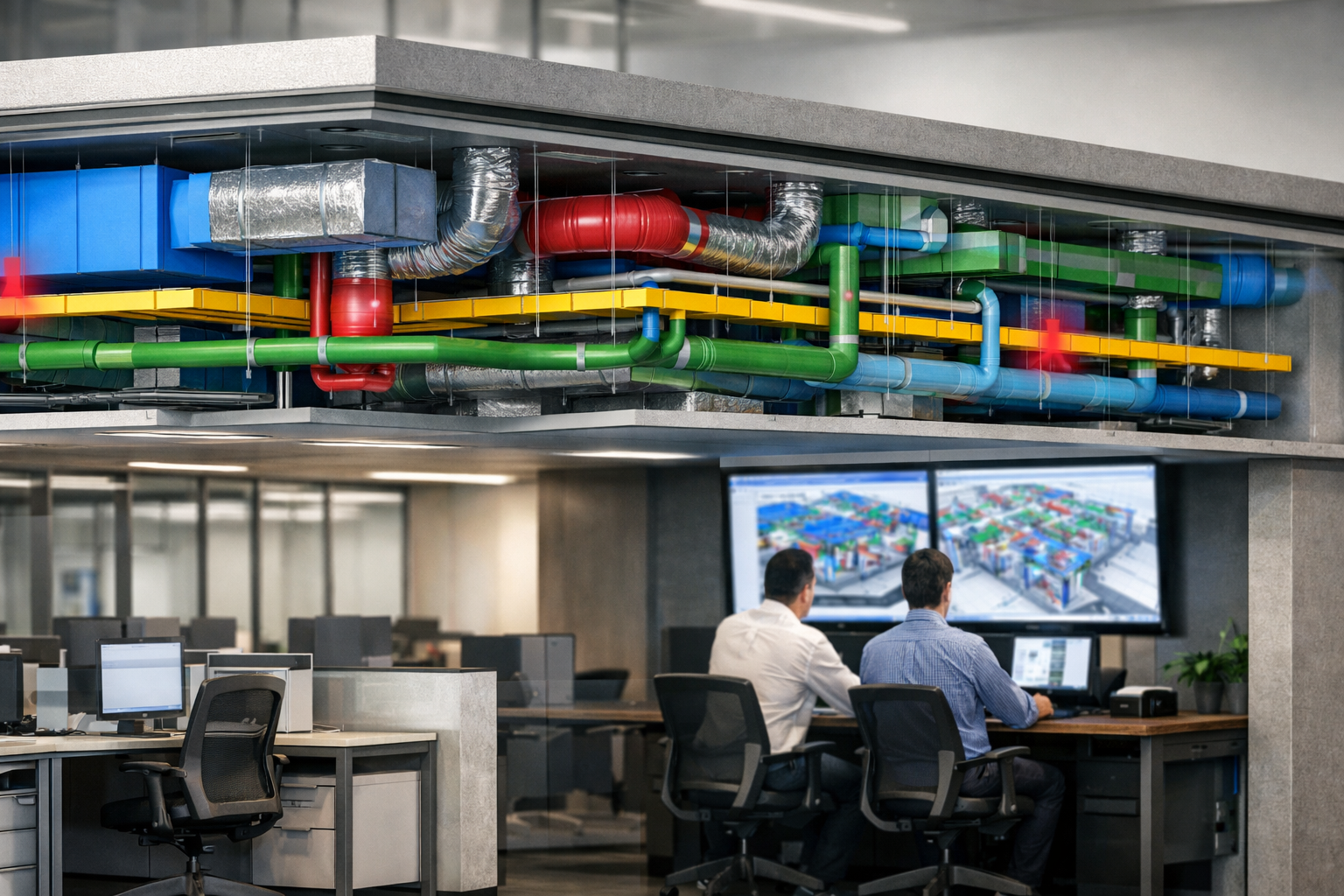
MEP Coordination Is Breaking Projects Long Before Construction Starts
In the US AEC industry, MEP coordination is still widely viewed as a construction-phase problem. When RFIs spike, schedules slip, and field teams struggle to “make it work,” the assumption is that coordination failed on site.
That assumption is fundamentally flawed.
In reality, most MEP-related project breakdowns are already locked into the project months before construction begins – during design development and BIM coordination. By the time construction teams encounter these issues, they are no longer design problems. They are business risks.
This blog takes a deep, workflow-driven look at why MEP coordination is breaking projects upstream, how risk is silently transferred downstream, and what disciplined AEC firms are doing differently to prevent failure before construction ever starts.
They become construction-ready only when:
MEP Coordination Is Breaking Projects Long Before Construction Starts
The Growing Weight of MEP in Modern Buildings
MEP systems are no longer secondary to architecture and structure. In many projects, they are the dominant systems shaping feasibility.
Across commercial, healthcare, data center, education, and mixed-use developments, projects now face:
• Larger HVAC systems driven by performance and energy codes • Dense ceiling plenums with limited vertical tolerance • Complex electrical, low-voltage, and life-safety integration • Higher expectations for prefabrication and modular installation
Despite this reality, many coordination workflows are still built around outdated assumptions—treating MEP as something that can be “fit in later.”
That gap between system complexity and coordination maturity is where projects begin to fail.
The False Comfort of Early BIM Models
Early BIM models often create a dangerous sense of confidence.
At schematic and early DD stages:
• Systems appear routed • Major equipment appears placed • Major clashes may not yet appear
But visual completeness is not coordination completeness.
What’s often missing at this stage:
• Verified clearances for installation and maintenance • Realistic routing tolerances • Constructability checks against structure and architecture • System hierarchy and priority decisions
When these gaps are ignored early, they don’t disappear. They compound.
Why “We’ll Fix It Later” Becomes a Project Killer
One of the most persistent habits in AEC workflows is deferring coordination until “the model is more developed.”
In practice, this means:
• Spatial conflicts are postponed • Systems are modeled optimistically • Decisions are deferred to future phases
The problem is that by mid-DD:
• Floor-to-floor heights are locked • Shaft sizes are fixed • Structural grids are frozen • Equipment rooms are constrained
At that point, coordination is no longer about optimization. It becomes about damage control.
IFC: The Moment Risk Quietly Changes Hands
Issued for Construction (IFC) drawings are often treated as proof that coordination is complete.
Contractually, IFC allows construction to proceed. Operationally, it often signals something very different.
On many projects, IFC simply means:
• Submission deadlines were met • Models are “complete enough” • Outstanding coordination issues are assumed manageable
When IFC is issued without closed coordination and QA/QC sign-off, risk is transferred:
• From designers to contractors • From controlled design environments to the field • From low-cost fixes to high-cost rework
This is why RFIs often surge immediately after IFC – not months later.
How MEP Coordination Actually Breaks Down
Discipline-Centric Modeling Silos
Mechanical, electrical, plumbing, fire protection, and low-voltage teams often optimize within their own scopes.
Without enforced cross-discipline ownership:
• Each system works in isolation • Spatial conflicts accumulate invisibly • No one owns the “whole ceiling”
Individually correct models combine into collectively unbuildable conditions.
Visual Coordination Without Verification
Many coordination reviews stop at “it looks like it fits.”
But critical checks are skipped:
• Access zones for valves, dampers, panels • Installation sequencing constraints • Prefabrication tolerances • Trade stacking logic
These issues don’t always show up as hard clashes—but they fail in the field.
Late, Batch-Based Clash Detection
Clash detection is still treated as a milestone activity instead of a continuous process.
Late clashes force:
• Rerouting under pressure • Compromised system performance • Field-driven decision-making
At that stage, coordination becomes reactive—and expensive.
Without hard gates, unresolved risks quietly pass downstream.
What Happens When These Issues Reach Construction
Once construction begins, the cost of coordination failure escalates rapidly.
Common outcomes include:
• RFIs within the first 30–60 days of mobilization • Trade rework before first inspectionsTrade rework before first inspections • Schedule float consumed early • Increased change orders • Erosion of trust between teams
At this stage, even small modeling decisions can trigger major project disruption.
The Core Issue: Coordination Is Treated as Modeling, Not Control
The industry often frames MEP coordination as a BIM production task.
The difference is not tools or software. It is discipline and accountability.
What Effective Pre-Construction MEP Coordination Looks Like
Effective teams implement coordination as a structured workflow:
• Early spatial zoning of MEP systems • System hierarchy rules established upfront • Continuous clash detection with ownership • Constructability-focused reviews, not just geometry checks • Formal QA/QC sign-off before IFC
When this happens, coordination issues are resolved when they are cheap, not when they are catastrophic.
Why Many Firms Can’t Sustain This Internally
Even firms that understand the problem face real constraints:
• BIM teams are fully utilized • Senior coordinators are pulled into firefighting • Project timelines compress • Hiring experienced coordination talent is slow and risky
As pressure increases, coordination rigor is often the first thing sacrificed.
How eLogicTech Supports Upstream MEP Coordination
eLogicTech Solutions supports US AEC firms as a virtual extension of in-house BIM and MEP teams, helping enforce coordination discipline before construction begins.
Support typically includes:
• Dedicated MEP BIM coordination resources • Independent BIM QA/QC audits • Pre-IFC coordination validation • Continuous clash detection and resolution support • Constructability-focused model reviews
The objective is not more drawings. It is fewer downstream surprises.
Final Takeaway
MEP coordination failures do not originate on site. They originate when coordination is postponed, rushed, or under-resourced during design.
IFC does not eliminate risk. It transfers it.
Firms that treat MEP coordination as a pre-construction control process—not a late-stage modeling task—protect their schedules, budgets, and reputations long before construction starts.